Review Management Software Terms Explained: A Plain-English Glossary
If you've been shopping for help with your online reviews, you've probably hit a wall of jargon: drip campaigns, review gating, aggregators, API integrations. This review management software glossary cuts through all of it in plain English. Use it to decode sales calls, compare plans line by line, and spot the stuff a provider hopes you won't ask about. No fluff, no corporate-speak, just the terms you actually need.
- Review Management Software: the tool that runs the whole show
- Review Automation: asking for reviews without lifting a finger
- Review Request: the message that asks a customer to review you
- Drip Campaign: a scheduled series of follow-up messages
- QR Review Device: a scannable card or stand customers tap or scan
- Review Gating: filtering out unhappy customers before they post (don't do it)
- Review Response: your public reply to a review
- Sentiment Analysis: software reading the mood of your reviews
- Review Widget: reviews displayed on your own website
- Google Business Profile: your free listing on Google Maps and Search
- Local SEO: showing up when nearby customers search
- Review Velocity: how fast new reviews come in
- Star Rating Average: the number everyone judges you by
- Review Aggregator: a service that pulls reviews from many sites into one place
- API Integration: two pieces of software talking to each other
- White-Label: someone else's software with a different name on it
- Onboarding: the setup process after you sign up
- Per-Location Pricing: paying separately for each business location
The Core Tools and How They Work
These are the nuts and bolts, the terms every provider will throw at you in the first five minutes.
Review Management Software Tools and Capabilities
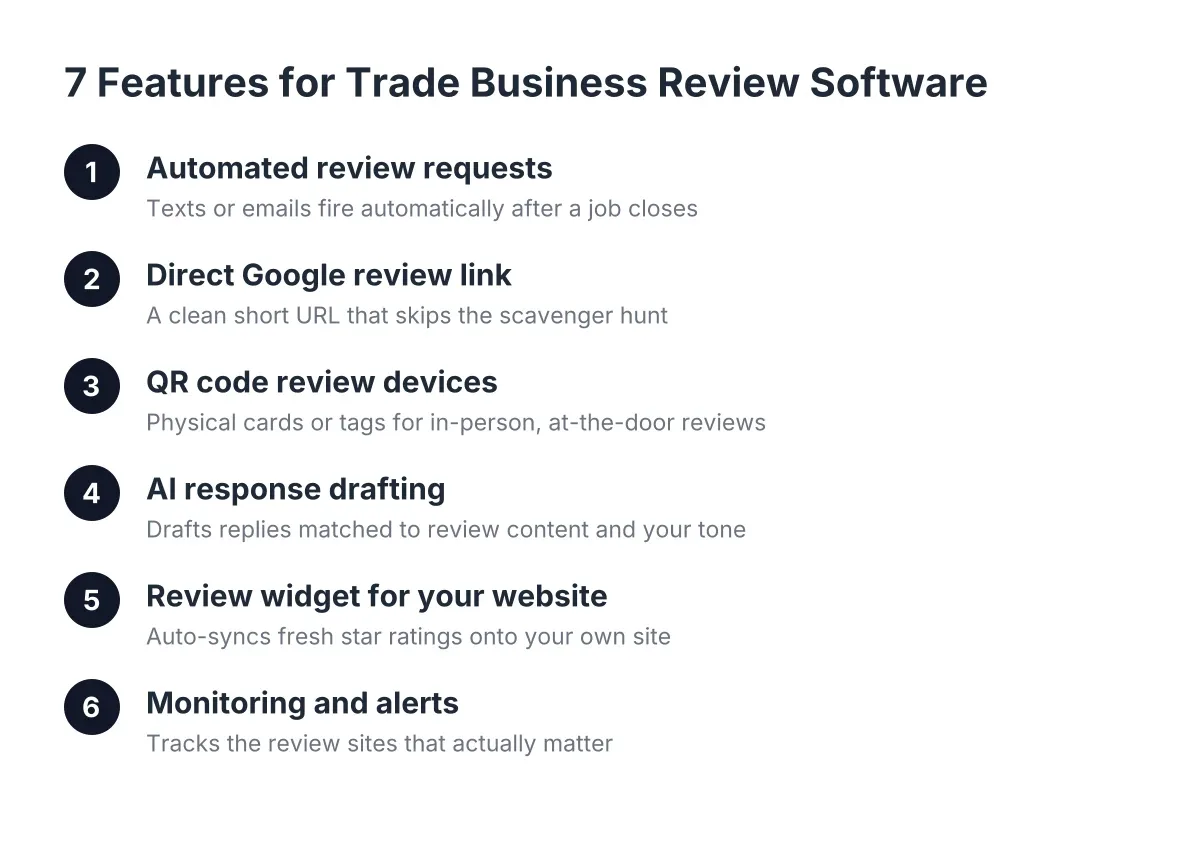
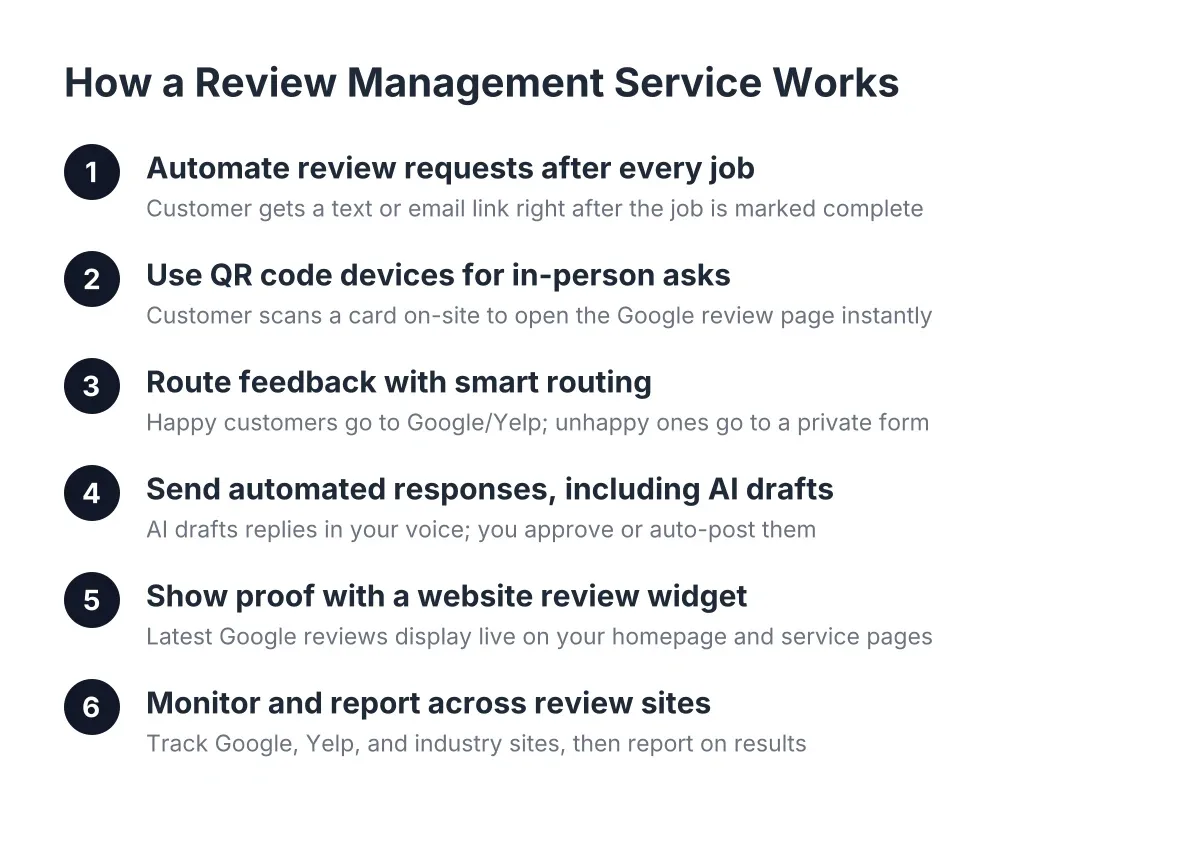
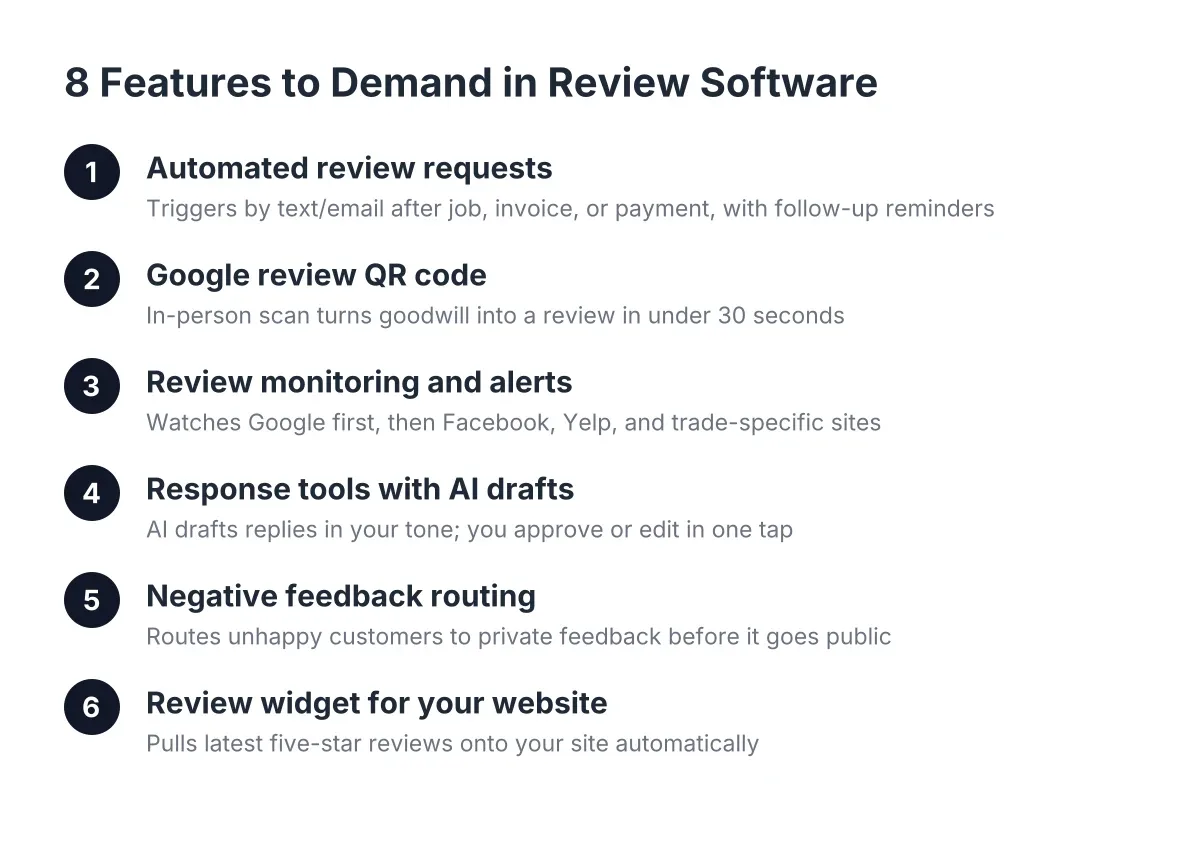
Review management software is a tool that helps a business collect, monitor, respond to, and display customer reviews from one dashboard. Instead of logging into Google, Facebook, and five other sites separately, you handle everything in one place. When a provider pitches you review management software, ask which review sites it covers and whether responding to reviews is included or extra. The good ones automate the asking, not just the watching.
Review Automation
Review automation means software sends review requests to your customers automatically, usually right after a job or sale. You stop relying on memory or awkward in-person asks. This matters because most happy customers will leave a review if asked at the right moment, and almost none will if you never ask. If a plan includes AI-powered automation, that usually means the software also picks the best timing and wording for each request.
Review Request
A review request is the text message or email that asks a customer to leave you a review, usually with a direct link to your review page. The fewer taps between the ask and the review form, the more reviews you get. Ask any provider to show you an actual request their system sends. If it looks like spam to you, it looks like spam to your customers.
Drip Campaign
A drip campaign is a scheduled series of messages sent over days or weeks, so customers who ignore the first review request get a gentle follow-up. One ask converts some customers; a polite second or third ask converts far more. A provider offering drip campaigns is telling you their system handles persistence for you. Confirm you can cap the number of follow-ups so nobody feels pestered.
QR Review Device
A QR review device is a physical card, sticker, or stand with a scannable code that takes a customer straight to your review page. It works at the counter, on the job site, or at the table, anywhere a happy customer is standing in front of you. We sell these because the moment right after great service is when people actually say yes. If a provider offers them, ask whether the device links to your real review profile or to a middleman page first.
Review Widget
A review widget is a small block of code that displays your reviews directly on your own website. Visitors see your five-star feedback without leaving your site, which builds trust at the exact moment they're deciding whether to call you. If your website and reviews come from the same provider, the widget usually updates itself. If they come from different providers, ask who handles the connection.
Reputation, Rankings, and the Stuff Google Cares About
This section of the glossary covers the review management software terms that explain why reviews move the needle on search, not just on trust.
Google Business Profile
A Google Business Profile is the free listing that shows your business on Google Search and Google Maps, including your reviews, hours, photos, and contact info. For most local businesses, it gets seen more than the website itself. Reviews on this profile directly affect where you show up when someone nearby searches for what you do. Any provider worth hiring will ask about your profile before anything else.
Local SEO
Local SEO means the work of making your business show up in search results for people searching near you, like "plumber near me." Reviews are a major ingredient: Google favors businesses with more reviews, better ratings, and recent activity. A provider bundling local SEO with reviews is connecting two things that genuinely feed each other. Ask them to explain how, specifically, their review work supports your rankings.
Review Velocity
Review velocity is the pace at which your business earns new reviews over time. A steady stream of recent reviews signals to Google, and to customers, that you're active and still good at what you do. Fifty reviews from three years ago beat nothing, but ten fresh ones this quarter beat both. This is the metric review automation exists to improve.
Star Rating Average
Your star rating average is the overall score, usually out of five, calculated from all your reviews on a given site. Customers filter by it, and many won't consider anything under four stars. One bad review hurts a business with ten reviews far more than a business with two hundred, which is another argument for volume. Protect the average by earning reviews consistently, not by hiding the bad ones.
Sentiment Analysis
Sentiment analysis is software reading your reviews and sorting them by mood: positive, negative, or neutral. It helps you spot patterns, like three reviews in a month mentioning slow callbacks, without reading every word yourself. It's useful at volume and mostly decorative if you get two reviews a month. Don't pay a premium for it until your review count justifies it.
Review Aggregator
A review aggregator is a service that collects your reviews from many sites, Google, Facebook, industry directories, and shows them in one feed. It saves you from checking each site manually and makes sure no review goes unanswered. Ask which sites an aggregator actually monitors; "all major platforms" should come with a specific list. Missing the one directory your industry lives on defeats the purpose.
Red Flags, Fine Print, and Pricing Terms
Know these before you sign anything.
Review Gating
Review gating means asking customers how they feel first, then only sending happy ones to the public review page while routing unhappy ones to a private form. Google's policies prohibit it, and getting caught can tank your profile. If a provider pitches "filtering" or "pre-screening" reviews, that's gating with a nicer name. The honest move is asking everyone and handling criticism in public like a grown-up.
Review Response
A review response is your public reply to a customer's review, visible to everyone who reads it. Responding to negative reviews calmly shows future customers how you handle problems, which often matters more than the complaint itself. Some plans include response templates or AI-drafted replies; others leave responding entirely to you. Ask which one you're buying, because unanswered one-star reviews age badly.
API Integration
An API integration is a connection that lets two software tools share data automatically, like your invoicing app telling your review software a job just finished. It's what makes "automatic" actually automatic; the review request fires without you typing anything. If a provider says they integrate with your existing tools, ask them to name yours specifically. "We can probably connect to that" and "we already do" are different answers.
White-Label
White-label means a provider sells you software built by another company, with their own branding slapped on top. It's not automatically bad, but it affects support: when something breaks, your provider may be waiting on the real builder to fix it. Ask who built the platform and who answers when it goes down. Founder-led shops that own their stack can usually tell you in one sentence.
Onboarding
Onboarding is the setup period after you sign up, when the provider connects your review profiles, imports customer data, and configures your messages. A clean onboarding takes days; a messy one drags for weeks while you pay for software you can't use yet. Ask for a specific timeline and what they need from you before day one. Vague answers here predict vague everything.
Per-Location Pricing
Per-location pricing means you pay a separate fee for each physical business location you manage in the software. One shop, one fee; three shops, three fees, sometimes with a volume discount. It's standard in this industry, but it's also where quotes quietly balloon. If you're comparing plans, like a Basic, Pro, and Growth tier, confirm whether the quoted price covers one location or all of yours.
Using These Terms
You can now read a reviews quote line by line and know exactly what you're paying for, what's standard, and what's a red flag dressed up in software-speak. That's the whole point of this glossary for review management software: sharper questions, fewer surprises, and a provider who knows you can't be snowed. Whoever you hire, make them earn it.
If you need web design, Revenue Goblin can help.