Is It Illegal to Leave a Negative Google Review? Your Rights, Their Limits
If a customer left you a one-star rating and you searched whether it is illegal to leave a negative Google review, here is the short version: no, honest negative reviews are legal and protected. The longer answer matters more, because there are real lines reviewers can cross, and real rights you have as a business owner when they do.
This FAQ walks through both sides. You will learn when a bad review is protected speech, when it becomes defamation, what Google will and will not remove, and what you can actually do about it as a solo operator or small team who does not have a legal department on speed dial.
Is it illegal to leave a negative Google review?
Leaving a negative Google review is not illegal as long as the review reflects the reviewer's honest opinion or true experience. In the United States, truthful reviews and statements of opinion are protected speech. A customer who says your crew showed up late and left a mess has every right to post that, even if it stings.
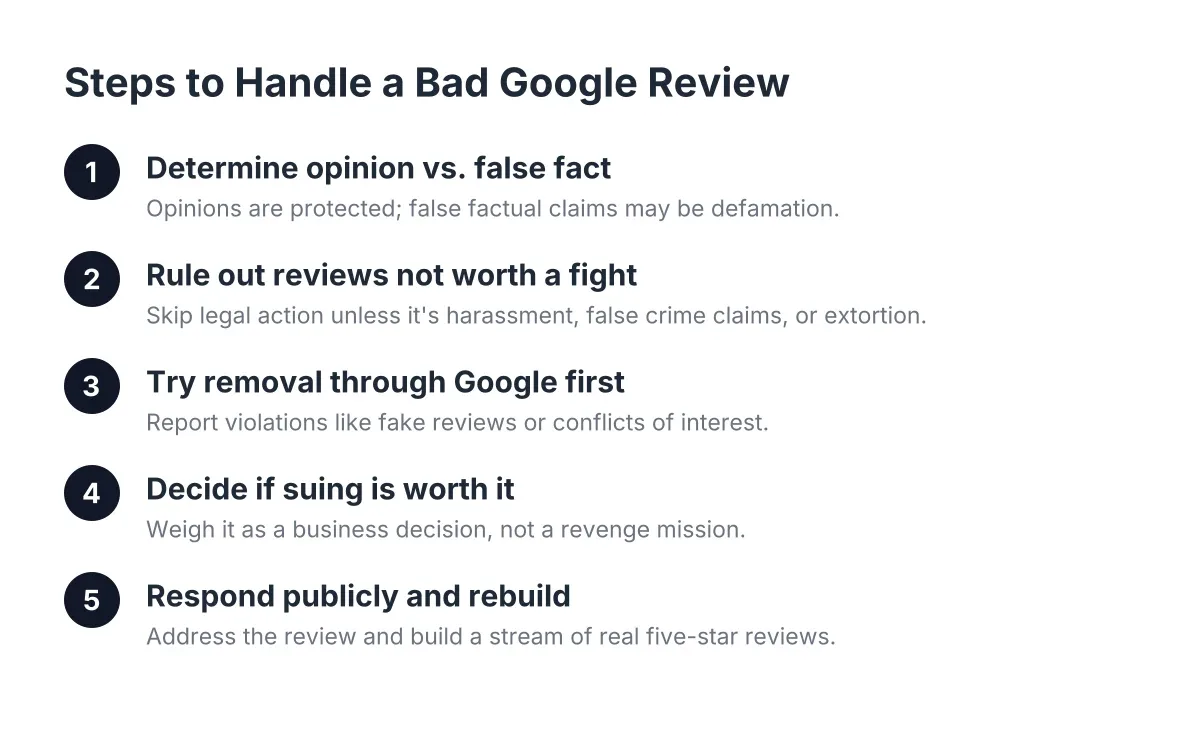
The law draws the line at false statements of fact. Opinion ("the price felt high") is protected. A fabricated factual claim ("they stole tools from my garage" when nothing of the sort happened) is not. That distinction drives everything else in this article.
Federal law also protects reviewers from businesses trying to silence them. The Consumer Review Fairness Act makes it illegal for a business to use contract terms that ban or penalize honest reviews. According to the Federal Trade Commission, it is illegal to ban honest reviews through form contracts. So no, you cannot bury a "no negative reviews" clause in your service agreement. That clause would be void, and enforcing it could get you in trouble.
When does a negative Google review cross into illegal territory?
A negative Google review becomes legally actionable when it contains false statements of fact that damage a business, which is defamation. It can also cross the line into extortion if someone demands money or free work to remove it, or into fraud if the reviewer never did business with you at all.
Here are the main categories where a reviewer loses legal protection:
- Defamation: stating false facts as if they were true, such as claiming a plumber caused a flood that never happened.
- Extortion: "Pay me $500 or the one-star stays up." That is a crime, not a review.
- Fake reviews: reviews from people who were never customers, including competitors posing as customers.
- Harassment campaigns: organizing a brigade of strangers to tank a business's rating over something unrelated to its service.
Notice what is missing from that list: harsh opinions, unfair-feeling ratings, and reviews that exaggerate how annoyed someone was. Those are legal, even when they hurt.
Can a company sue you over a Google review?
A company can sue over a Google review, but it can only win if the review contains provably false statements of fact that caused damage. Suing over an honest opinion is a losing case, and in many states it can backfire badly under anti-SLAPP laws, which penalize lawsuits designed to silence criticism.
For a local service business, the practical math rarely works. Suppose a roofer in Ohio gets a one-star review claiming the crew "used the wrong shingles." Even if the claim is wrong, a defamation suit could run tens of thousands of dollars in legal fees, drag on for a year, and generate worse publicity than the review itself. In that scenario, a calm public reply and a removal request usually beat a lawsuit on both cost and outcome.
If a review contains a serious false accusation, criminal allegations, or claims costing you real contracts, talk to an attorney before doing anything. That is the one area of this topic where professional advice is worth the hourly rate.
Can companies get rid of bad Google reviews?
Companies can get bad Google reviews removed only when the review violates Google review policy, such as fake engagement, spam, off-topic content, conflicts of interest, or harassment. Google does not remove reviews just because they are negative, and no legitimate service can force removal of an honest one-star review.
The removal process is straightforward: flag the review from your Business Profile, choose the policy violation, and wait. Google evaluates the report against its content rules, not against your feelings about the rating. Honest-but-brutal reviews stay up. Reviews from someone who was never a customer, reviews mentioning a competitor's name suspiciously often, or reviews containing slurs have a real shot at coming down.
Be skeptical of anyone selling guaranteed review removal. If a company promises to delete legitimate negative reviews for a fee, they are either flagging and praying or doing something that violates Google's terms. Either way, you are the one holding the risk.
Is it illegal for a business to tell people to leave negative reviews?
Encouraging people to leave negative reviews about a competitor is not automatically illegal, but it violates Google's fake engagement rules, and it becomes illegal when the reviews contain false claims or the campaign amounts to tortious interference. Asking people who never used a business to review it is against policy regardless of the star count.
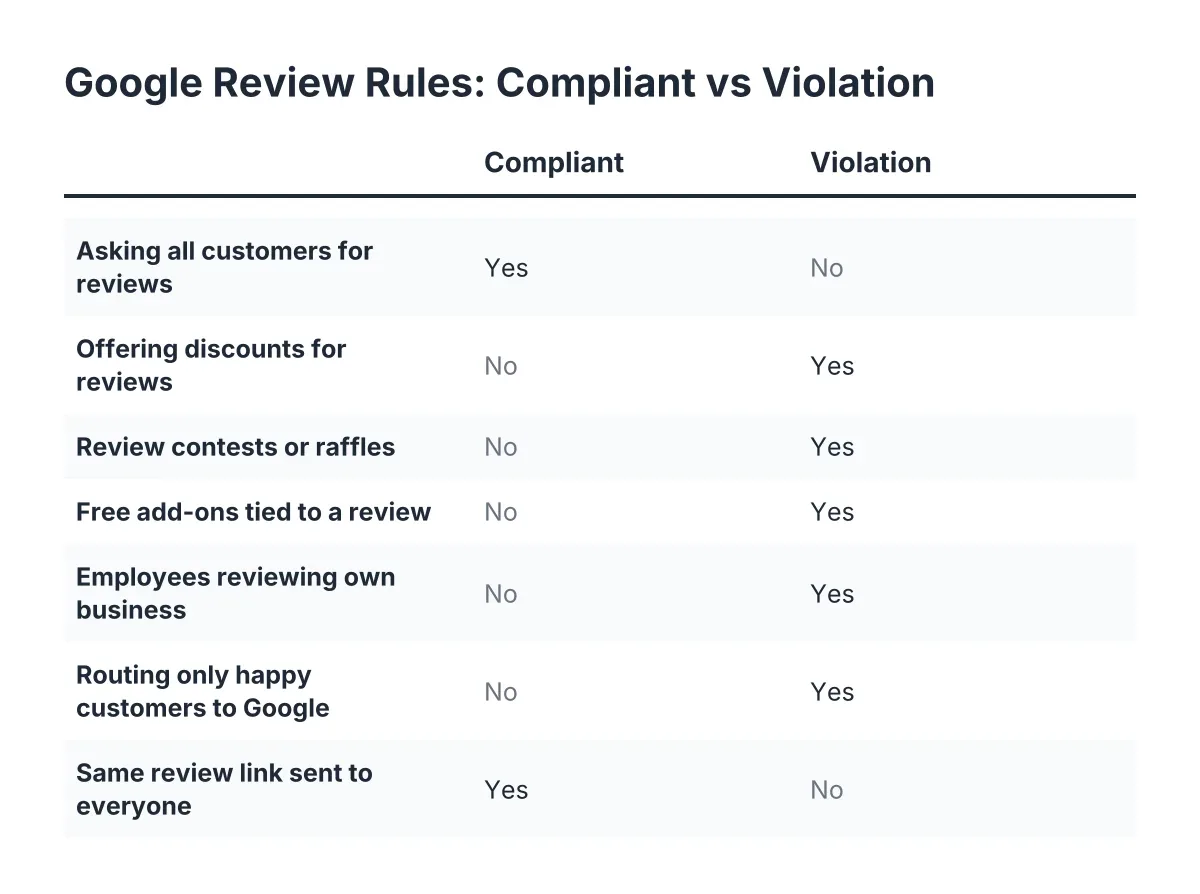
The same logic applies in reverse, and this is where a lot of well-meaning owners trip up. Paying for five-star reviews, review-gating (only asking happy customers after screening them), and posting reviews of your own business all violate Google's rules. As of 2026, Google and the FTC both treat fake positive reviews as seriously as fake negative ones, and FTC rules now carry civil penalties for buying or selling fake reviews.
What are the rules for Google reviews in 2026?
Google's review rules in 2026 still center on the same core requirements: reviews must reflect a genuine customer experience, contain no fake engagement, stay on topic, and avoid harassment, hate speech, and conflicts of interest. Businesses cannot incentivize reviews, gate them, or review themselves, and reviewers cannot post about businesses they never used.
Enforcement has tightened rather than the rules changing dramatically. Google leans harder on automated detection, which means bursts of suspicious activity, such as 30 reviews appearing in one weekend, get flagged faster. For a small HVAC or landscaping outfit, the takeaway is simple: collect reviews steadily and honestly, and the system works in your favor.
Other platforms run their own versions of these rules. The Airbnb review policy, for example, requires reviews to be relevant and unbiased, and the Airbnb review removal policy allows takedowns for violations, not for mere negativity. The pattern holds everywhere: platforms protect honest criticism and punish manipulation.
How often can you leave a Google review for a company?
A Google user can leave only one review per business, and that review stays until the user edits or deletes it. A customer cannot stack five separate one-star reviews on your profile; if they try from multiple accounts, that is fake engagement and flaggable.
Customers can update their existing review after a new experience, though. A two-star review from 2024 can become a five-star review in 2026 if you fix the relationship. That is worth remembering before you write off an unhappy customer as a lost cause.
What should a small business do about a negative review instead of fighting it?
The highest-return response to a negative review is a calm, specific public reply plus a steady pipeline of new reviews from happy customers. According to BrightLocal, 88% of consumers say they would use a business that replies to all of its reviews, compared to just 47% for a business that never responds. Your reply is marketing to the next hundred readers, not an argument with one angry one.
Here is the playbook that actually works:
- Reply within 48 hours, acknowledge the specific issue, and offer to make it right offline.
- Flag the review only if it genuinely violates policy; do not flag honest criticism and hope.
- Ask your recent happy customers for reviews so the negative one gets diluted and buried.
- Fix the operational problem the review exposed, if there is one.
Volume is your real defense. Google hosts about 73% of all online reviews, more than six times its nearest competitors combined, according to Exploding Topics. And 93% of consumers say online reviews impact their purchase decisions, per Exploding Topics. One bad review sitting among 80 good ones is a rounding error. One bad review sitting among 6 total is a crisis. The fix is not legal; it is systematic review collection.
The bottom line on negative reviews and the law
It is not illegal to leave a negative Google review, and trying to muscle honest criticism offline usually costs more than the review ever would. The law protects truthful reviews, Google removes only policy violations, and lawsuits make sense only for genuinely false and damaging claims.
Too many great local businesses lose to bigger, worse competitors simply because the competitor has 200 reviews and they have 12. Stop treating the occasional one-star as a legal problem. Treat it as a math problem, and solve it with volume, fast replies, and work that earns the five stars on its own.
If you need web design, Revenue Goblin can help.