Can You Sue Someone for a Bad Google Review? Legal Liability Explained
You got a one-star review this morning, and it stings. Maybe it's unfair, maybe it's flat-out false, and now you're wondering: can you sue someone over a bad review? The short answer is yes, in specific situations, but the honest answer is that a lawsuit should be the last tool you reach for, not the first. This guide walks you through the exact steps to figure out whether you have a case, what to try before calling a lawyer, and how to protect your reputation either way.
Let's be clear up front. Most bad reviews are not lawsuit material. They're opinions, and opinions are protected speech. But false statements of fact that damage your business cross a legal line, and you have options when they do. Here's how to work through it, step by step.
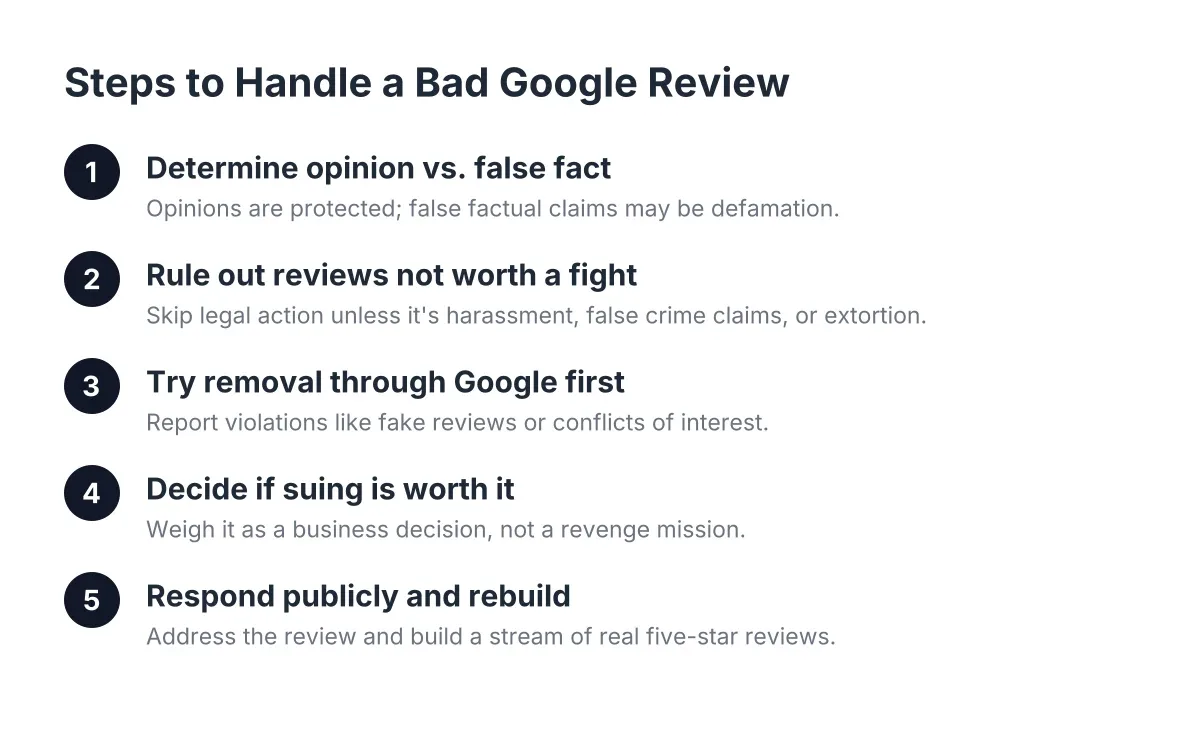
Step 1: Determine Whether the Review Is Opinion or False Fact
Before anything else, figure out what kind of review you're dealing with. This single distinction decides whether a lawsuit is even on the table.
Opinion is protected. "The technician was rude and the price felt high" is an opinion. You cannot sue someone for having a bad experience and saying so, even if their take is unfair or exaggerated. That's how free speech works, and courts protect it aggressively.
False statements of fact are different. "This plumber never showed up and kept my $500 deposit" is a factual claim. If it never happened, it may be defamation. In writing, defamation is called libel; spoken, it's slander. A Google review is written, so libel is the relevant category.
Ask yourself: could the statement be proven true or false? If yes, and it's false, keep reading. If it's just a harsh opinion, skip to Step 5 and focus on your response strategy instead.
Can you sue someone over a bad review for defamation?
Yes, you can sue someone for defamation of character over a Google review, but only if the review contains a false statement of fact, published to others, that caused real harm to your business. All three elements must be present. A review that's merely negative, rude, or one-sided doesn't qualify, no matter how much it hurts.
To win a defamation case, you generally need to show:
- A false statement of fact. Not opinion, not exaggeration, an actual checkable claim that is untrue.
- Publication. The statement was seen by others. A public Google review clears this bar automatically.
- Fault. The reviewer knew it was false or acted with reckless disregard for the truth.
- Damages. You lost bookings, revenue, or measurable reputation value because of it.
That last one matters more than most owners realize. Courts want evidence of harm, like a drop in calls after the review went live, canceled jobs, or customers who mention it directly.
Step 2: Rule Out the Reviews That Aren't Worth a Fight
Not every infuriating review justifies legal action, and knowing which battles to skip saves you money and stress.
First, is it illegal to leave a bad review on Google? No. Leaving a negative review is legal everywhere in the United States, as long as the review is honest. Consumers have a federally protected right to share truthful opinions about businesses. The Consumer Review Fairness Act even blocks businesses from using contract clauses to gag customers.
However, some reviews do cross legal lines beyond defamation. You may have grounds to act if a review involves:
- False accusations of crimes. Claiming you stole from a customer's home when you didn't is the kind of false accusation courts take seriously.
- A pattern of harassment. One bad review is speech. Fifteen fake accounts posting the same attack may support a harassment or tortious interference claim.
- A competitor posing as a customer. Fake reviews from someone who never hired you can violate the law and Google's rules at the same time.
- Extortion. "Pay me $1,000 or I'll leave more one-star reviews" is a crime, not a review.
In addition, think about damages honestly. Can you sue someone for emotional distress over a bad review? In theory, in extreme harassment cases; in practice, courts rarely award it for a single negative review. Business defamation cases live or die on economic harm, not hurt feelings.
Step 3: Try to Remove the Review Through Google First
Before you spend a dime on lawyers, work Google's own removal process. It's free, it's faster than litigation, and it resolves a meaningful share of fake-review problems.
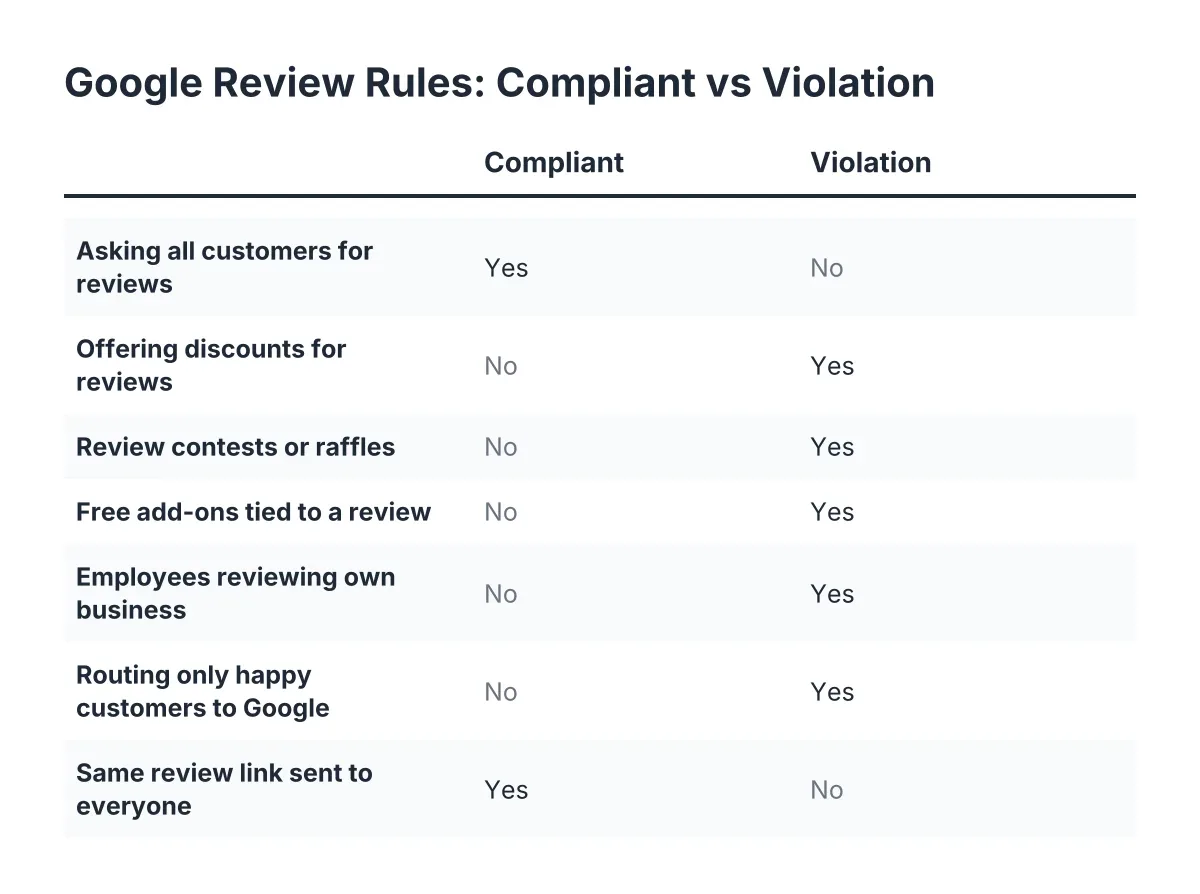
Google review policy prohibits fake engagement, impersonation, off-topic rants, harassment, and conflicts of interest like competitor reviews. If the review violates any of these rules, you can flag it directly from your Business Profile. Here's the sequence:
- Open your Google Business Profile and find the review.
- Click the three-dot menu and select "Report review."
- Choose the violation category that fits, such as "fake" or "conflict of interest."
- Document everything with screenshots and dates before you report, in case the review changes or disappears.
- Wait for Google's decision, which typically takes days to a few weeks.
Can companies get rid of bad Google reviews this way? Only the ones that break the rules. Google will not remove a review just because it's negative or because you dispute the customer's version of events. An honest one-star review stays up, period. That's by design, and it's why your long-term defense is volume: a steady stream of real five-star reviews that makes one outlier irrelevant.
The stakes here are bigger than one review. Google hosts about 73% of all online reviews, more than six times as many as its nearest competitors combined, according to Exploding Topics. Your Google profile is the courtroom where most customers judge you.
Step 4: Decide Whether Suing Someone Over a Bad Review Is Worth It
Say the review is provably false, Google won't remove it, and it's costing you work. Now the lawsuit question gets real, and you need to weigh it like a business decision, not a revenge mission.
Here's an illustrative scenario. Suppose an HVAC owner with a three-person crew gets a review claiming his company "caused a gas leak and refused to fix it." No such job exists in his records. He can document that two scheduled installs canceled the week the review appeared, about $9,000 in lost revenue. That's a case with false facts and measurable damages, the two things a defamation claim needs.
Even then, count the costs before you file:
- Legal fees. A defamation suit commonly runs $10,000 to $50,000 or more through trial. Those are illustrative ranges; your attorney will give you real numbers.
- Time. Expect a year or longer, and expect it to pull you away from running jobs.
- Anti-SLAPP risk. Many states have laws protecting consumer speech. If a court decides your suit targets legitimate opinion, you can be ordered to pay the reviewer's legal fees. Whether you can sue someone for court costs cuts both ways.
- The Streisand effect. Suing a customer can generate far more negative attention than the original review ever did.
- Collectability. Winning a judgment against an individual with no assets may net you nothing.
For most local service businesses, a demand letter from an attorney resolves things faster and cheaper than a lawsuit. A letter stating the review is false, documenting the harm, and requesting removal often works, because most reviewers would rather delete a post than hire a defense lawyer.
This is the point where you need a professional. Defamation law varies by state, anti-SLAPP statutes are a minefield, and one wrong move can turn you from plaintiff into defendant. Talk to a business attorney licensed in your state before sending anything or filing anything.
Step 5: Respond Publicly and Rebuild With Real Reviews
Whatever you decide legally, respond to the review. Future customers judge you by your reply more than by the complaint itself. According to BrightLocal, 88% of consumers say they would use a business that replies to all of its reviews, compared to just 47% for a business that never responds.
Keep your public reply short, calm, and factual. Something like: "We have no record of serving you and take this claim seriously. Please contact us directly so we can resolve this." No arguing, no lawyering in the comments, no matching their energy.
Then go on offense the legitimate way. One bad review surrounded by 80 genuine five-star reviews loses its power. Nearly all consumers, 93% according to Exploding Topics, say online reviews impact their purchase decisions, so the fastest path past a bad review is burying it in good ones. Ask every happy customer at the moment the job wraps, when their satisfaction is highest. Automating that ask, whether through text follow-ups or a QR device on the truck, is what separates businesses with 12 reviews from businesses with 200.
One trade-off worth naming: review recovery takes months, not days. There's no shortcut that doesn't violate Google's rules, and buying or faking reviews will get your profile penalized or wiped.
Quick Answers Before You Go
Can a company sue you over a bad review?
Yes, a company can sue a reviewer over a bad review, but only winnable cases involve false statements of fact that caused measurable harm. Honest negative reviews, even brutal ones, are protected speech. If you're the reviewer and you told the truth, the law is firmly on your side.
How often can you leave a Google review for a company?
Google allows one review per account per business. You can edit or update your existing review after new experiences, but posting multiple reviews for the same business from one account, or using multiple accounts to pile on, violates Google's policies and can get the reviews removed.
Is it worth suing over a single bad review?
Rarely. Suing over one bad review usually costs more in fees, time, and attention than the review itself ever will. The exceptions are provably false factual claims with documented financial harm, extortion attempts, or coordinated fake-review attacks. For everything else, flag it, respond professionally, and outnumber it with real reviews.
The bottom line: yes, you can sue, but the businesses that win online rarely need to. They make one bad review statistically irrelevant.
If you need web design, Revenue Goblin can help.