Website Conversion Optimization Terms Explained: A Plain-English Glossary
You started researching why your website isn't bringing in customers, and now you're drowning in acronyms. This website conversion optimization glossary translates the jargon into plain English so you can read a proposal line by line, ask providers pointed questions, and spot the difference between real work and buzzword padding. Every entry here defines the term first, then tells you why it matters to your business. No fluff, no homework required.
- Conversion: a visitor doing the thing you wanted
- Conversion Rate: the percentage of visitors who act
- Conversion Rate Optimization (CRO): the work of raising that percentage
- Call to Action (CTA): the button or link asking for the next step
- Landing Page: a page built for one job
- Bounce Rate: visitors who leave without doing anything
- A/B Testing: comparing two versions to see which wins
- Funnel: the path from stranger to customer
- Above the Fold: what shows before anyone scrolls
- Mobile-First Design: building for phones before desktops
- Page Speed: how fast your site loads
- Social Proof: reviews and signals that you're trustworthy
- Friction: anything that makes acting harder
- Lead: a visitor who raised their hand
- Heatmap: a visual of where people click and scroll
- Value Proposition: the one-sentence reason to pick you
Essential Terms in Website Conversion Optimization Glossary
These are the terms at the heart of any website conversion optimization glossary, and the ones a provider will use in the first five minutes of a sales call. If a proposal doesn't touch these, it's decoration, not strategy.
Conversion
A conversion is any action you want a website visitor to take, such as calling you, filling out a form, or booking an appointment. It's the whole reason your website exists. A pretty site that never converts is a brochure nobody reads. Before you hire anyone, decide what counts as a conversion for your business; everything else in this glossary flows from that answer.
Conversion Rate
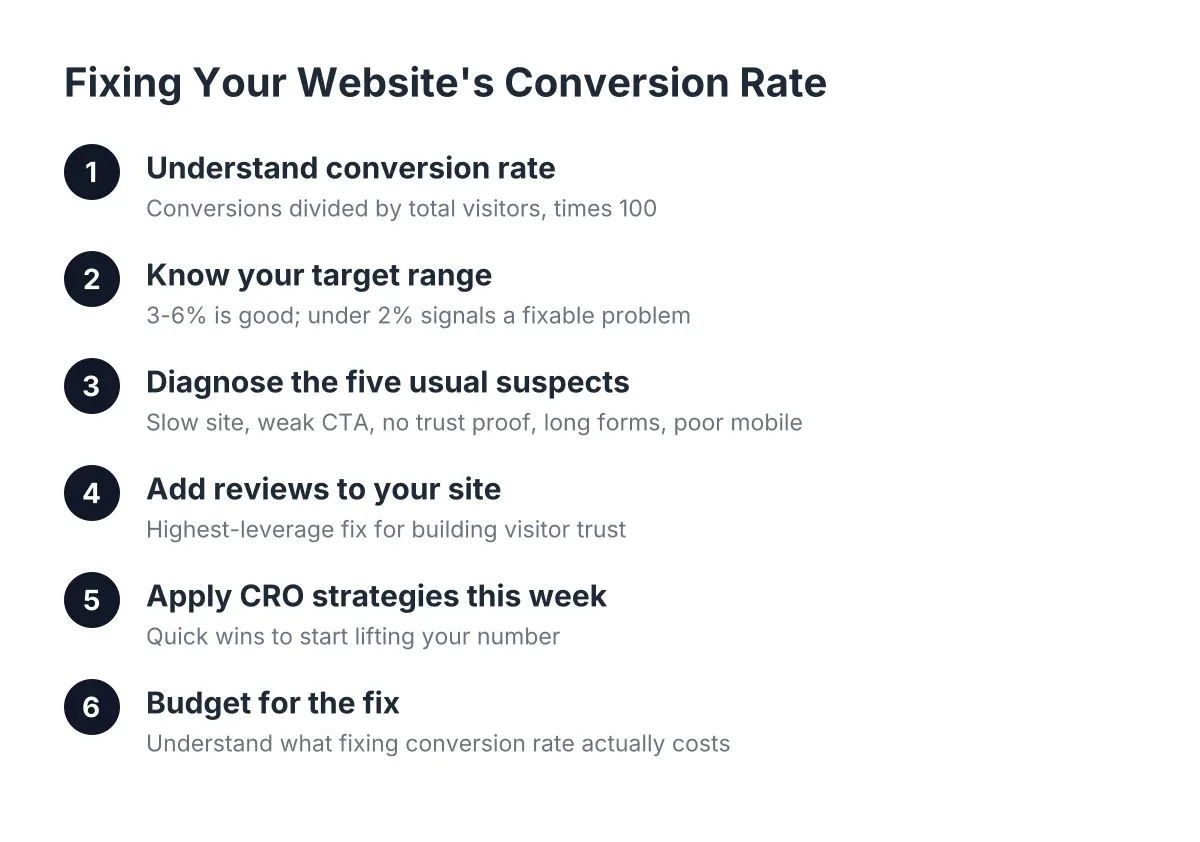
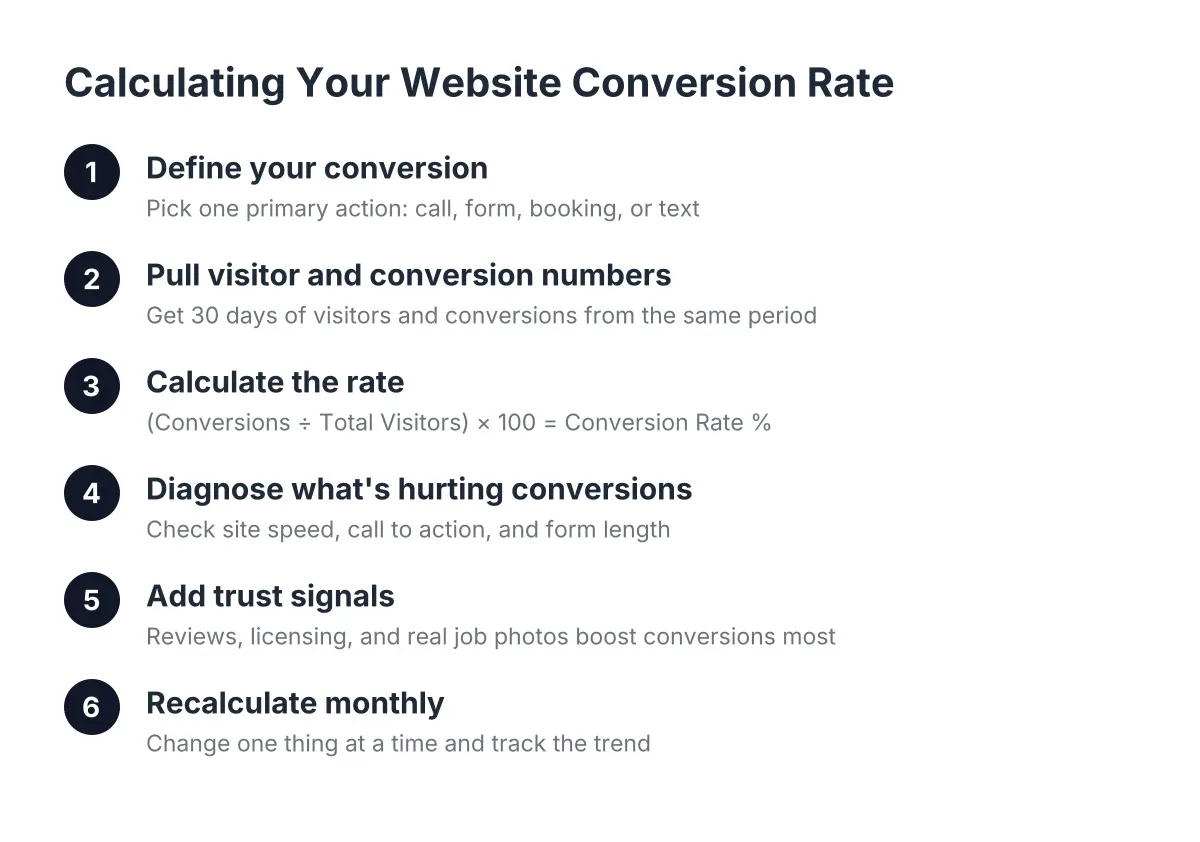
Conversion rate is the percentage of website visitors who take the action you want, calculated by dividing conversions by total visitors. If 100 people visit and 3 call you, your conversion rate is 3 percent. This number matters more than raw traffic, because doubling your conversion rate doubles your leads without spending another dime on ads. When a provider quotes results, ask whether they mean more visitors or a better conversion rate; those are different jobs with different price tags.
Conversion Rate Optimization (CRO)
Conversion rate optimization is the practice of improving a website so a higher percentage of visitors take action, using changes to design, copy, speed, and layout. It's detective work: find where visitors give up, fix that spot, and measure whether the fix worked. Serious CRO relies on data and testing, not someone's gut feeling about button colors. If a provider pitches website conversion optimization without mentioning how they'll measure results, ask. "We'll make it look better" is not a plan.
Call to Action (CTA)
A call to action is the button, link, or line of text that tells a visitor exactly what to do next, such as "Book a Call" or "Get a Quote". Weak CTAs like "Learn More" leave people wondering what happens when they click. Strong ones name the outcome. If your site's main CTA is buried at the bottom of the page or missing entirely, that's often the cheapest fix with the biggest payoff.
Funnel
A funnel is the path a visitor follows from first landing on your site to becoming a customer, narrowing at each step as people drop off. Picture 500 visitors, 50 who view your contact page, and 5 who actually reach out. CRO work often means finding the step where the most people leak out and plugging that hole first. A provider who talks about "fixing the funnel" is promising to find those leaks, so ask which step they'd tackle first and why.
Value Proposition
A value proposition is the short, clear statement of why a customer should choose you over the competition. It answers "what do you do, for whom, and why you" in one breath. Too many great businesses lose to bigger, worse brands because their homepage never says this plainly. If a visitor can't repeat your value proposition after five seconds on your site, no amount of design polish will save the conversion rate.
Measuring and Testing in Website Conversion Optimization
You can't improve what you don't measure. These terms cover how providers figure out what's broken and prove their fixes worked.
Bounce Rate
Bounce rate is the percentage of visitors who leave your website after viewing only one page, without clicking anything. A high bounce rate usually signals a mismatch: the page loaded slowly, looked untrustworthy, or didn't answer the visitor's question. It's a smoke alarm, not a diagnosis. If a provider cites your bounce rate as a problem, ask what they think is causing it before agreeing to a fix.
A/B Testing
A/B testing means showing two versions of a page to different visitors and measuring which version produces more conversions. Version A might have one headline, version B another; the numbers pick the winner instead of opinions. It's the honest way to settle design arguments. Fair warning: A/B testing needs enough traffic to produce trustworthy results, so for a low-traffic local site, a provider may reasonably skip it and rely on proven patterns instead.
Heatmap
A heatmap is a visual report showing where visitors click, tap, and scroll on your website, with hot colors marking heavy activity. It reveals uncomfortable truths, like the fact that nobody scrolls past your third paragraph or everyone clicks an image that isn't a link. Heatmaps are a diagnostic tool, not a fix. A provider using them is doing real detective work rather than guessing.
Lead
A lead is a visitor who has shared contact information or reached out, showing real interest in buying from you. Leads are the currency of a small business website; a form fill, a phone call, and a booked consultation all count. When comparing providers, ask how they'll track leads back to the website, because "your site looks great now" pays zero bills. Leads you can count do.
Design Choices That Move the Needle
These terms describe the physical layout and build decisions that decide whether visitors stay, trust you, and act.
Landing Page
A landing page is a standalone web page built for one specific goal, usually tied to an ad, an email, or a single service. Unlike your homepage, which juggles many jobs, a landing page strips away distractions so the visitor faces one clear choice. If you're running ads that dump people onto a generic homepage, you're likely paying for clicks that go nowhere. A dedicated landing page is the standard fix.
Above the Fold
Above the fold means the portion of a web page visible before anyone scrolls, borrowed from the newspaper term for the top half of the front page. Many visitors never scroll, so what sits above the fold carries outsized weight. Your value proposition and main CTA belong there. If a provider's mockup buries the phone number three screens down, push back.
Mobile-First Design
Mobile-first design means building a website for phone screens first, then adapting it for larger screens, instead of the other way around. Most local searches happen on phones, often by someone standing in their kitchen with a problem right now. A site that works on desktop but breaks on mobile bleeds conversions daily. Any provider quoting you a new build should treat mobile-first as the default, not an upsell.
Page Speed
Page speed is how quickly your website loads and becomes usable for a visitor. Slow pages kill conversions because people leave before your site finishes rendering, and search engines rank slow sites lower too. Speed depends on how the site is built and where it's hosted, which is why hosting quality belongs in the conversation. Ask any provider how they'll keep the site fast after launch, not just on day one.
Social Proof
Social proof is evidence from other people, such as reviews, ratings, and testimonials, that shows your business is trustworthy. Visitors trust strangers who've bought from you more than they trust your own marketing, which is human nature at work. A steady stream of recent reviews often moves conversions more than any redesign. That's why review generation, including automated requests after each job, sits inside serious conversion work rather than off to the side.
Friction
Friction is anything on your website that makes taking action harder, like a ten-field contact form, a hidden phone number, or a confusing menu. Every extra step costs you some percentage of would-be customers. Good CRO is often subtraction: fewer fields, fewer clicks, fewer decisions. When reviewing a proposal, ask what the provider plans to remove, not just what they plan to add.
Using These Terms
You now hold what this website conversion optimization glossary was built to give you: the vocabulary to read a quote line by line and know what each item actually does. When a provider says they'll "reduce friction above the fold and add social proof", you can nod, then ask which conversion they're targeting and how they'll measure it. Sharp questions get honest answers, and honest answers get you a website that earns its keep.
If you need web design, Revenue Goblin can help.