Website and Reviews Cost Terms Explained: A Plain-English Glossary
If you own a small business and you're shopping for a website, review software, or both, you've probably hit a wall of jargon in every quote. This website and reviews cost glossary translates the terms providers throw around so you can read a proposal line by line, ask sharper questions, and spot the places where vague language hides extra cost. Nothing here requires a tech background. Thirty seconds per term, and you'll know more than most of the people sending you quotes.
- Custom Website Design: built for you, not from a dropdown
- Template Website: pre-made design with your logo swapped in
- Mobile-First Design: phones get designed for first
- Local SEO: showing up when nearby people search
- Hosting: the rent your website pays to stay online
- Domain Name: your web address, renewed yearly
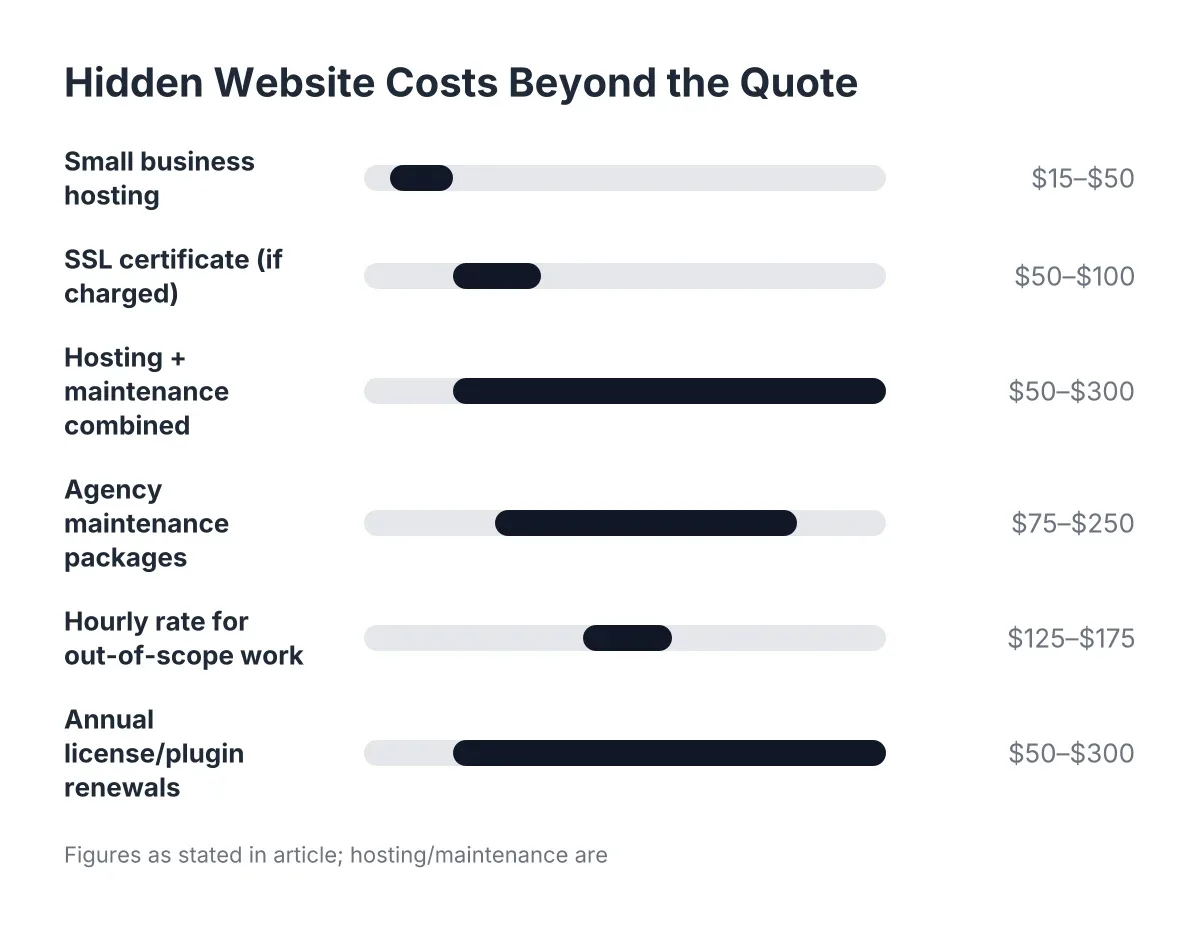
- SSL Certificate: the padlock that says your site is safe
- Review Automation: software that asks customers for reviews so you don't have to
- Review Gating: filtering reviews before they go public (don't do it)
- QR Review Device: a tap-or-scan gadget that opens your review page
- Reputation Management: watching and responding to what people say about you online
- Review Velocity: how steadily new reviews come in
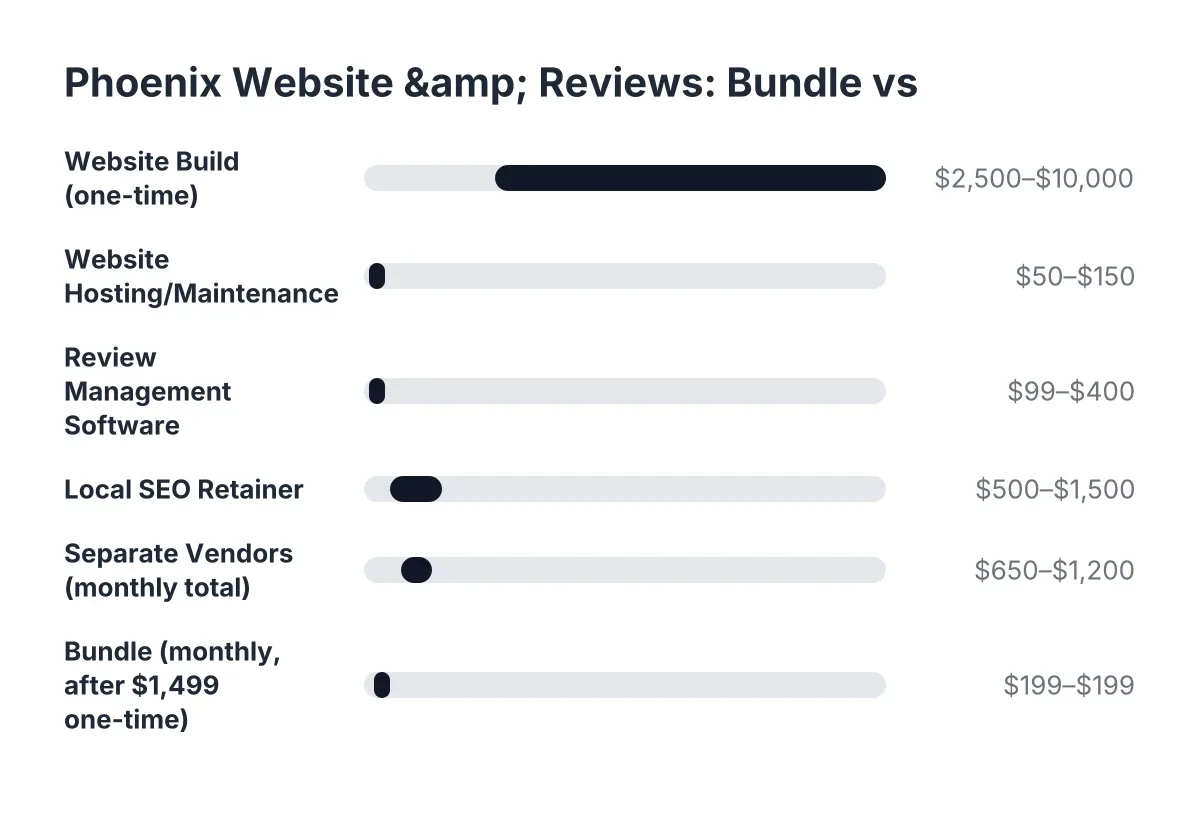
- Setup Fee: one-time cost to get everything built and launched
- Recurring Fee: the monthly or yearly cost that keeps things running
- Scope of Work: the written list of exactly what you're paying for
- Payment Processing Fees: the cut taken from every card transaction
- Maintenance and Support: who fixes things after launch, and what that costs
- ROI (Return on Investment): whether the thing pays for itself
Website Terms
These are the words that show up on the website side of a quote. They decide most of the website and reviews cost you'll see on paper, so it pays to know what each one actually buys you.
Custom Website Design
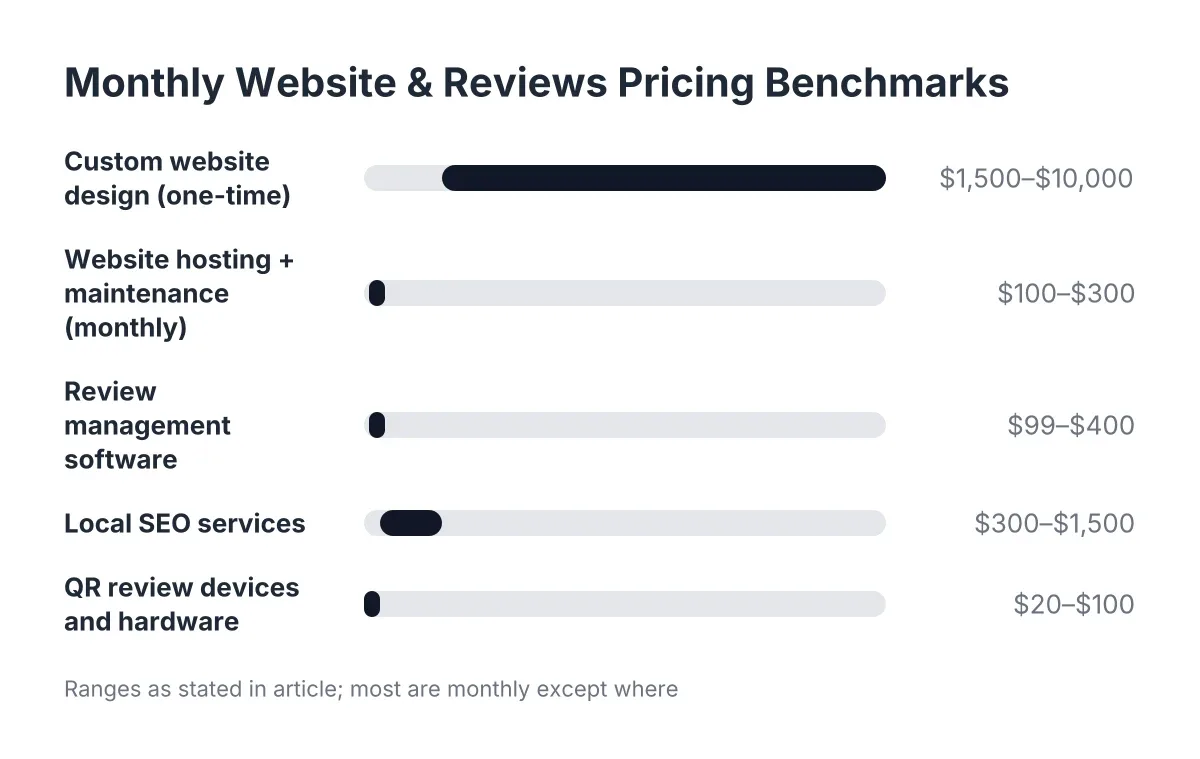
A custom website design is a site built specifically for your business, from the layout to the words to the structure, instead of assembled from a pre-made template. It matters because a custom build is shaped around what makes you money: your services, your area, your customers. When a provider quotes custom design, expect a higher upfront price than a template, but also expect the site to do a job rather than just exist. Ask what "custom" includes; some shops call a recolored template custom.
Template Website
A template website is a site built on a pre-designed layout that gets your logo, colors, and text dropped into it. Templates are cheaper and faster, which is fine if you just need to exist online. The catch is that hundreds of other businesses may be running the same bones, and templates rarely bend to fit how your business actually works. If a quote seems suspiciously cheap, this is usually why. Too many great businesses lose to bigger, shittier brands partly because their site looks like everyone else's.
Mobile-First Design
Mobile-first design means the site gets designed for phone screens before desktop screens, not shrunk down as an afterthought. Most local customers will find you on a phone, often standing in a parking lot or sitting on a couch. If the quote doesn't mention mobile, ask directly, because a site that fumbles on a phone fumbles the majority of your traffic. A provider who leads with mobile-first is signaling they design for how people actually search.
Local SEO
Local SEO is the work of making your business show up when people nearby search for what you do. It covers things like your service pages, your business listings, and how your site is structured so search engines understand where you operate. It matters because showing up on page one for "your service near me" is where new customers come from. When a quote includes local SEO, ask whether it's one-time setup or ongoing work, because those are two different line items with two different price shapes.
Hosting
Hosting is the service that keeps your website's files on a server so people can load your site at any hour. Think of it as rent for your spot on the internet. Hosting is almost always a recurring fee, either bundled into a monthly package or billed separately. If a provider bundles hosting with support, that's normal; just confirm what happens to your site if you ever stop paying or switch providers.
Domain Name
A domain name is your web address, like yourbusiness.com, registered in your name and renewed on a schedule, usually yearly. Here's the part that bites people: make sure the domain is registered to you, not to your web company. If the provider owns your domain, they own your address, and leaving them gets messy. It's a small recurring cost and a big ownership question, so ask who holds the keys.
SSL Certificate
An SSL certificate is the bit of technology that encrypts traffic between your site and a visitor's browser, shown as the padlock next to your address. Browsers flag sites without one as "not secure," which scares customers off before they read a word. Most decent hosting includes SSL at no extra charge now. If it appears as a separate paid line on your quote, ask why.
Review Terms and Website and Reviews Cost Planning
The review side of a quote has its own vocabulary, and it's where a lot of owners get lost fastest.
Review Automation and Its Place in Your Website and Reviews Cost
Review automation is software that automatically asks your customers for a review, usually by text or email, right after you've done the work. It matters because the number one reason good businesses have thin review profiles is simple: nobody asked. Automation turns "I keep meaning to ask" into a system that asks every time. When a provider quotes review automation, ask how customers get added, whether follow-up reminders are included, and which review platforms it points to. AI-powered versions can also help you draft responses to the reviews that come in.
Review Gating
Review gating is the practice of screening customers first and only sending happy ones to leave a public review. It sounds clever and it's against the rules on major review platforms, which can penalize or remove your reviews if you're caught. A legitimate review tool asks every customer and lets the chips fall. If a provider pitches gating as a feature, that's a red flag about how they operate, not a perk.
QR Review Device
A QR review device is a physical card, stand, or tag a customer taps or scans with their phone to jump straight to your review page. It removes the friction of "search for us and find the review button," which is where most would-be reviewers give up. These devices usually show up as a one-time hardware cost rather than a subscription. They work best at the moment of payment or handoff, when the customer is happiest.
Reputation Management
Reputation management means monitoring what people say about your business online and responding to it, especially reviews. For a small business, the practical version is simple: see every new review quickly, reply to all of them, and fix the problems negative ones reveal. It matters on a quote because "reputation management" can mean a full done-for-you service or just a dashboard you log into yourself. Ask which one you're buying, because the price difference is real.
Review Velocity
Review velocity is the pace at which your business collects new reviews over time. A steady stream of recent reviews signals to both customers and search engines that you're active and trusted right now, not three years ago. Fifty reviews from 2021 and silence since reads worse than you'd think. This is the metric review automation exists to move, so ask any provider how they'll keep reviews coming in month after month, not just during launch week.
Pricing and Paperwork
Setup Fee
A setup fee is the one-time charge for getting everything built, configured, and launched. For a website, that's the design and build; for review software, it's connecting your accounts and loading your customer flow. Setup fees are normal and honest when they're itemized. Be wary of quotes that hide setup inside a long contract instead, because that usually means you're paying it off slowly whether you stay or not.
Recurring Fee
A recurring fee is the ongoing monthly or yearly cost that keeps your website hosted, your review software running, and your support line answered. Recurring fees aren't a scam; servers and software genuinely cost money every month. The question to ask is what the fee covers and what happens when you cancel. Standalone review plans, like Basic, Pro, or Growth tiers, are a common example: you pick the level of automation and features, and the monthly price scales with it.
Scope of Work
A scope of work is the written list of exactly what a provider will deliver for the price quoted. It's the single most important document in any project, because disagreements almost always trace back to something that wasn't written down. "Website" is not a scope; "five pages, mobile-first, local SEO setup, review automation connected, hosting included" is. Before you sign anything, make sure every promise made on the sales call appears in the scope.
Payment Processing Fees
Payment processing fees are the percentage and per-transaction charges taken out of every card payment your business accepts. They're not a website cost, but they quietly drain more money from many small businesses than their website ever will. Some providers offer a payment processing evaluation, which means reviewing your current statements to see if you're overpaying. It costs you a statement and an hour, and it occasionally finds real money hiding in the fine print.
Maintenance and Support
Maintenance and support means the ongoing work of keeping your site updated, secure, and fixed when something breaks, plus a human to call when you need changes. The cheap quote without support isn't cheap once you're paying hourly for every text edit. Ask three things: what's included, how fast they respond, and whether small content updates cost extra. A provider who bundles hosting, support, and updates into one plan is selling predictability, which is usually what a busy owner actually wants.
ROI (Return on Investment)
ROI, or return on investment, is the measure of whether something you paid for brings back more money than it cost. For a website and review system, that means calls, bookings, and customers you can trace back to it, not vague "brand awareness." It matters because ROI is the only honest way to judge a quote: a cheap site that generates nothing is expensive, and a pricier one that books jobs every week is cheap. Ask every provider how you'll know it's working. If they can't answer in plain terms, keep shopping.
Using These Terms
What this website and reviews cost glossary gives you is leverage: you can now read a quote line by line, separate the real deliverables from the padding, and ask the questions that make a provider sweat a little. If a term on your quote isn't here and the provider can't explain it in one plain sentence, that tells you something too. You know enough now to shop like someone who can't be snowed.
If you need web design, Revenue Goblin can help.