Website and Reviews Pricing for Small Businesses: What You’ll Pay Monthly
If you've been Googling website and reviews pricing for small businesses, you've probably hit the same wall every local owner hits: nobody wants to give you a number. Agencies say "it depends." Software companies hide pricing behind a demo call. Meanwhile you just want to know if a fair deal looks like $100 a month or $1,000 a month before you sign anything.
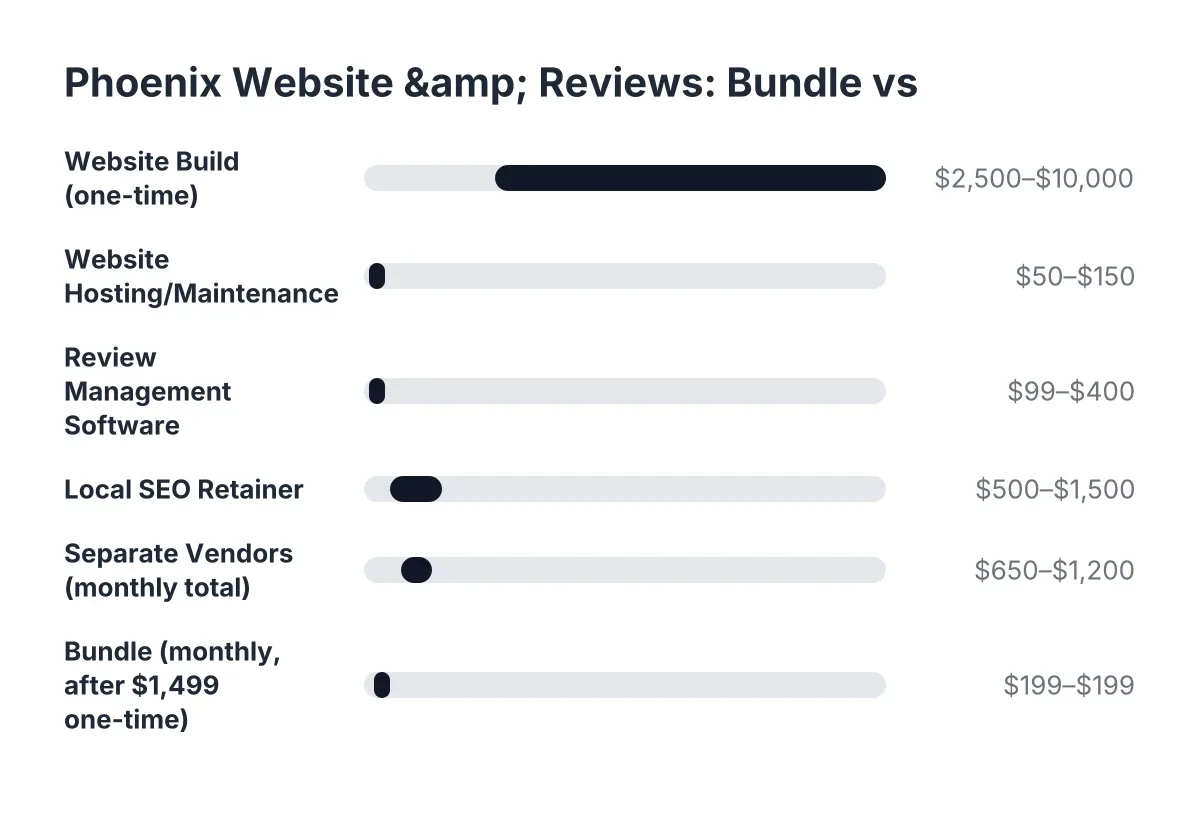
This article fixes that. Below are seven monthly website pricing benchmarks—real market ranges for websites, local SEO, and review management—so you can look at any quote and know within 30 seconds whether it's fair, inflated, or suspiciously cheap. For reference, our own model is $1,499 one-time plus $199 per month for a custom website, review automation, hosting, and support bundled together. Use that as one data point to benchmark against everything else you're quoted.
Here's why this matters more than most owners realize. According to BrightLocal, while 89% of small and midsize businesses invest in organic SEO, only 40% say they have a dedicated business website. That gap is an opportunity. The trades that get their online presence right, plumbers, HVAC techs, roofers, landscapers, win the jobs their competitors never even see.
1. Custom website design: expect $1,500 to $10,000 one-time
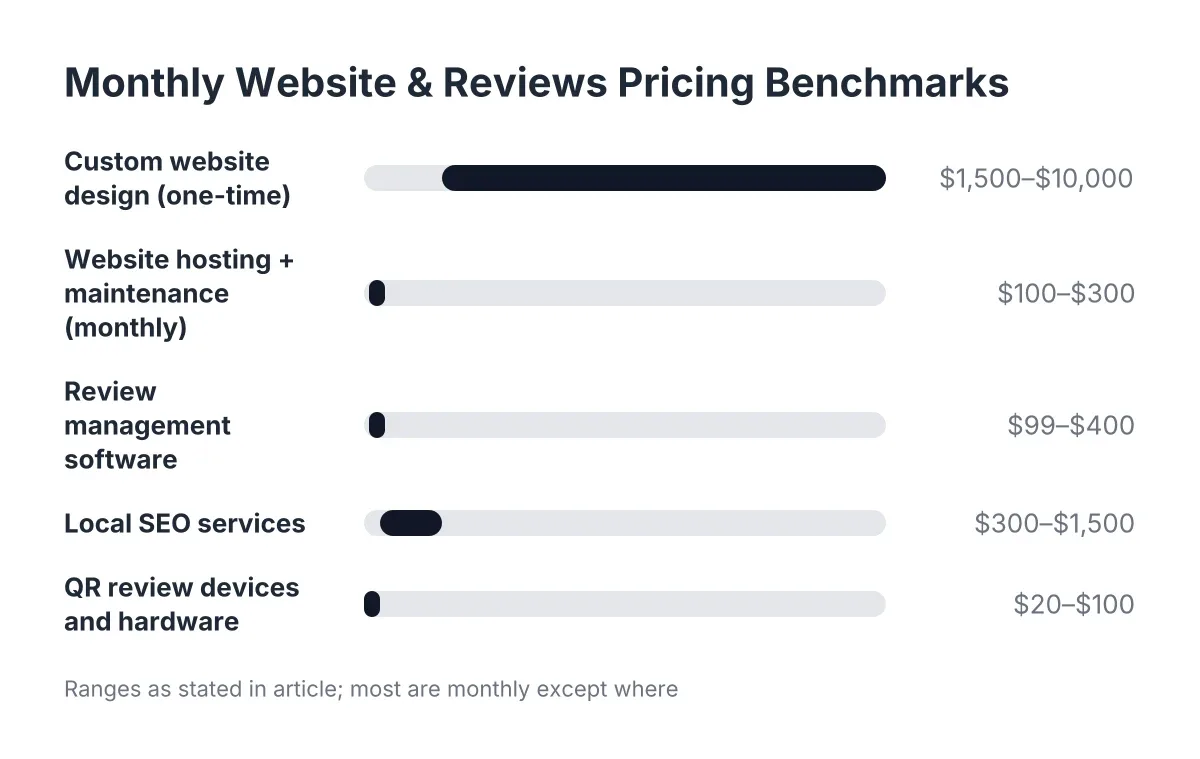
The average cost of website design for a small business runs anywhere from $1,500 on the low end to $10,000 or more from a traditional agency. The spread is that wide because you're paying for different things: a template with your logo slapped on, or a site actually built to convert local searchers into booked jobs.
For a local service business with 5 to 10 pages, mobile-first design, and basic on-page SEO, a fair 2026 price sits between $1,500 and $5,000 one-time. Below $1,000, you're usually getting a template someone filled in over a weekend. Above $10,000, you're paying for agency overhead, account managers, and meetings about meetings, not a better website.
One trap to watch: some shops quote low up front, then charge hourly for every change after launch. Ask what's included after the site goes live, in writing, before you sign.
2. What Monthly Website Pricing Benchmarks Include
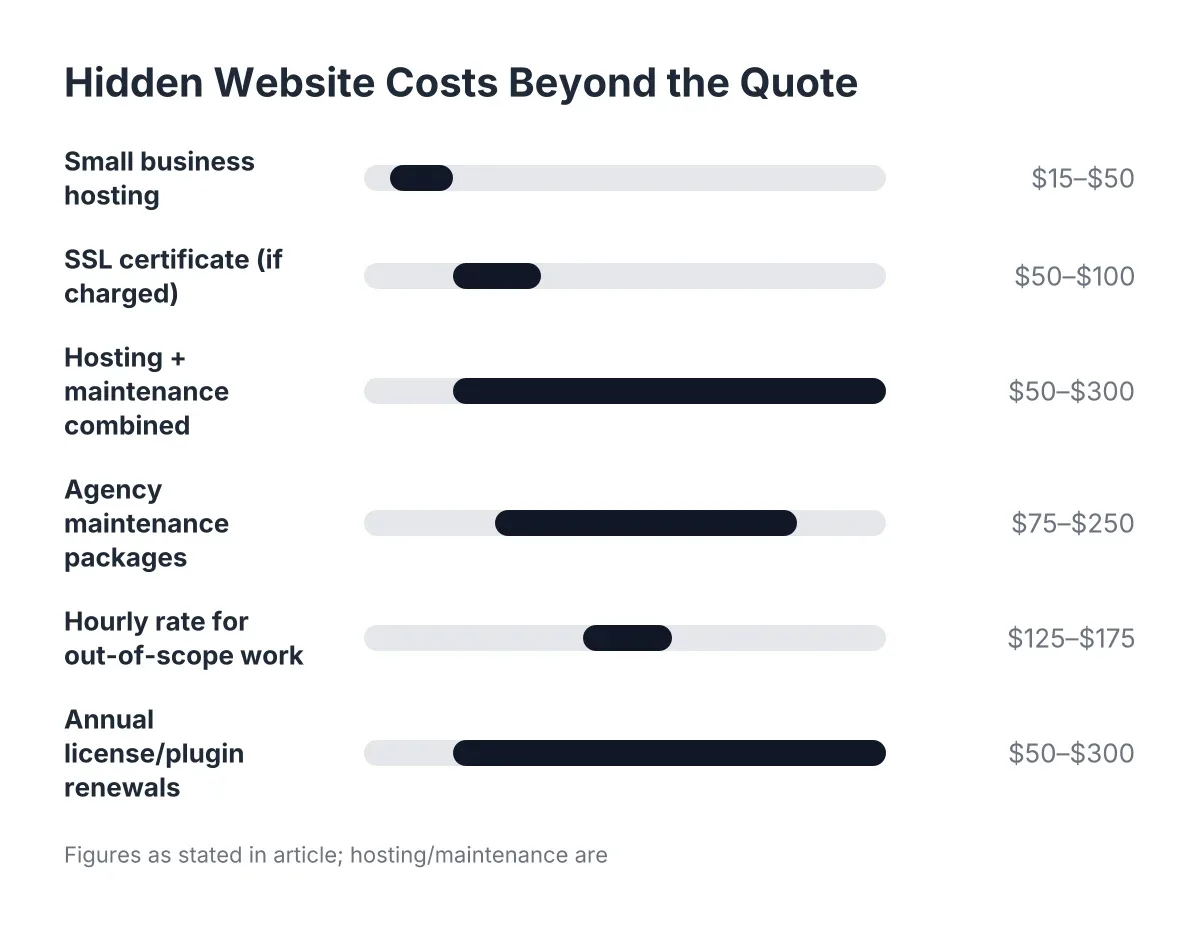
Monthly website pricing usually covers hosting, security, updates, and support. Standalone hosting with no support runs $20 to $50 a month. Hosting plus maintenance and content updates typically lands between $100 and $300 a month for a local business, and these monthly website pricing benchmarks reflect what you actually receive.
However, the monthly versus one-time question matters less than what the monthly fee actually buys. A $199 per month plan that includes hosting, ongoing SEO, review automation, and a human who answers when something breaks is a different product than $199 for hosting alone. Compare the contents, not just the number.
Here's a quick checklist of what a fair monthly plan should include:
- Hosting and SSL security
- Software and plugin updates
- Content changes (new photos, updated hours, seasonal offers)
- Someone to call when the site goes down
- Performance monitoring so you find problems before customers do
If a quote is vague on any of these, that vagueness is where the hidden fees live.
3. Review management software: $99 to $400 per month
Review management software pricing for small businesses generally runs $99 to $400 per month in 2026, depending on automation level and how many locations you manage. At the low end you get review request sending and monitoring. At the higher end you get automated requests triggered after each job, AI-drafted responses, and reporting.
This is money well spent for one blunt reason: Google hosts about 73% of all online reviews, more than six times as many as its nearest competitors combined, according to Exploding Topics. Google reviews for business visibility aren't optional anymore; they're the first thing a potential customer checks on Google Maps before calling you.
Our own standalone reviews plans run $99 to $399 per month (Basic, Pro, and Growth), which lands squarely in the market range. The variable that should drive your choice is automation. If you're a solo operator, you don't have time to manually text review requests after every job. Pay for the plan that does it for you.
4. Responding to reviews: free to do, expensive to skip
Responding to reviews costs nothing but time, and the payoff is measurable. According to BrightLocal, 88% of consumers say they would use a business that replies to all of its reviews, compared to just 47% for a business that never responds. That's a 41-point swing from something you can do from your phone.
The real cost shows up when you don't have time, which describes most owners running crews all day. That's where AI-assisted response tools inside review platforms earn their fee. They draft a response, you approve it in ten seconds, and your Google Maps reviews profile looks like a business that cares.
If you're evaluating software, make sure response management is included and not a paid add-on. Some platforms charge extra per response or gate it behind a higher tier.
5. Local SEO services: $300 to $1,500 per month, and most trades don't need the top end
The cost of local SEO services for a small business typically runs $300 to $1,500 per month in 2026. National SEO campaigns can run far higher, but a plumber serving three towns doesn't need a national campaign. You need your Google Business Profile optimized, consistent citations, location pages that rank, and a steady stream of reviews feeding your map pack position.
For most local service businesses, $300 to $700 per month of focused local SEO covers it. Anything above that should come with specific deliverables: pages built, rankings tracked, calls attributed. If an agency can't tell you what you're getting for the money each month, you're funding their retainer, not your rankings.
When comparing monthly website pricing benchmarks alongside SEO costs, be skeptical of SEO sold separately from your website. The site structure, page speed, and content are the SEO. Splitting them across two vendors usually means paying twice and getting finger-pointing when rankings stall.
6. QR review devices and hardware: $20 to $100 one-time
QR review cards and NFC tap devices are the cheapest line item in this whole stack, usually $20 to $100 one-time per device. A tech finishes a job, holds up the card, the customer taps or scans, and lands directly on your Google review page. No app, no searching, no friction.
These devices punch above their price because they solve the real review problem: not unwilling customers, but the gap between "sure, I'll leave a review" and actually doing it. Cutting that gap to five seconds at the moment of peak satisfaction is why review counts jump when crews carry them.
The trade-off is that hardware without follow-up automation only catches customers at the door. Pair devices with automated text or email requests and you cover both the in-person moment and the ones who got away.
7. The bundle math: what website plus reviews pricing looks like for small operations
A bundled website plus reviews package for a small local business typically costs $1,500 to $3,000 up front, plus $150 to $350 per month in 2026. That monthly covers hosting, support, local SEO basics, and review automation in one bill. Bought separately, the same pieces often total $400 to $800 per month across three or four vendors.
Suppose a two-truck HVAC company prices it both ways. Separately: $150 per month for website maintenance, $200 for review software, and $500 for a local SEO retainer, about $850 per month across three vendors who don't talk to each other. Bundled: one vendor at roughly $199 per month after a one-time build fee. In that scenario the bundle saves over $600 a month and, more importantly, puts the website, SEO, and reviews under one strategy instead of three competing invoices.
That's the core of why total website and reviews cost should be evaluated together rather than line by line. Reviews feed your rankings, rankings feed your traffic, and your website converts that traffic into booked jobs. Price any one piece in isolation and you miss how they compound.
One honest caveat: bundles only save money if you'd actually use every piece. If you already have a site you love that converts well, a standalone reviews plan at $99 to $399 per month is the smarter buy. Don't pay for a rebuild you don't need.
How to spot hidden fees before you sign anything
Hidden fees in web design contracts usually hide in four places: ownership, hourly change fees, cancellation terms, and third-party costs. Before signing any website or reviews contract, get written answers to these questions:
- Who owns the website and domain if I leave? If the answer isn't "you do," walk away.
- What do changes cost after launch? "Included" and "$150 per hour" are wildly different monthly realities.
- What happens to my reviews data if I cancel? Your Google reviews stay on Google, but your request history and contacts should export with you.
- Are hosting, SSL, and software licenses included, or billed separately? Surprise $40 line items add up.
- Is there a contract term, and what does early exit cost? Month-to-month after an initial period is the fair standard.
A vendor confident in their value answers these without flinching. Vagueness here predicts vagueness everywhere else.
The bottom line on website pricing benchmarks for small business reviews
Here's the whole article in one place. Fair 2026 market ranges for a local service business:
- Custom website build: $1,500 to $5,000 one-time
- Monthly website pricing benchmarks: $100 to $300 for hosting, updates, and support
- Review management software: $99 to $400 per month
- Local SEO: $300 to $700 per month for most trades
- QR review devices: $20 to $100 one-time
- All-in bundle: $1,500 to $3,000 up front, $150 to $350 per month
Benchmark every quote against these numbers. If an agency quote is double the range, ask exactly what the premium buys. If a quote is half the range, ask what got cut, because something did. For complex situations, multi-location operations, franchise restrictions, or industries with review-solicitation rules, it's worth getting professional advice before committing, since the standard playbook doesn't always apply.
Website and reviews pricing for a small business shouldn't require a decoder ring. You now have the ranges. The next quote that lands in your inbox, you'll know in half a minute whether it's fair. That's the position every owner should negotiate from.
If you need web design, Revenue Goblin can help.