Hidden Costs in Website and Review Services: What Vendors Don’t Tell You
You picked a vendor, or you're about to sign. Good. But before you do, you need to know about the hidden website vendor fees that services and review systems carry, ones that never show up in the proposal. The quote says one number. The invoice twelve months later says another. This guide breaks down exactly where those gaps come from, what fair 2026 pricing actually looks like, and how to benchmark any quote against a transparent model like $1,499 one-time plus $199 per month, so nothing surprises you after the contract is signed.
Here's the honest version: most vendors aren't scamming you. They're just quoting the part of the project that wins the deal and staying quiet about the parts that pay their rent. Your job is to ask about those parts before you sign, not after. Let's walk through every one of them.
Why Quotes and Invoices Rarely Match
The gap between a web design quote and the real first-year cost comes from scope, not dishonesty. A quote covers the build. It usually excludes hosting, maintenance, content changes, review software, and the small recurring fees that stack up. A $3,000 quote can become a $6,000 first year without anyone technically lying to you.
Think about how you quote your own work. If you're an HVAC contractor, your install price doesn't include the filter changes, the refrigerant top-ups, or the emergency call in February. Websites and review systems work the same way. The build is the install. Everything after is the service plan, and that's where vague vendors make their margin.
The fix is simple but tedious: price the full first year, not the sticker. Every section below gives you the real line items so you can do that math before you commit.
Hidden Website Vendor Fees: Breaking Down the Real Costs
The hidden website vendor fees in a web project cluster in five places: hosting and infrastructure, maintenance and updates, content changes, plugin and license renewals, and the dreaded hourly rate for anything not in the original scope. Each one is small on its own. Together they routinely double the advertised price.
Hosting, SSL, and the infrastructure stack
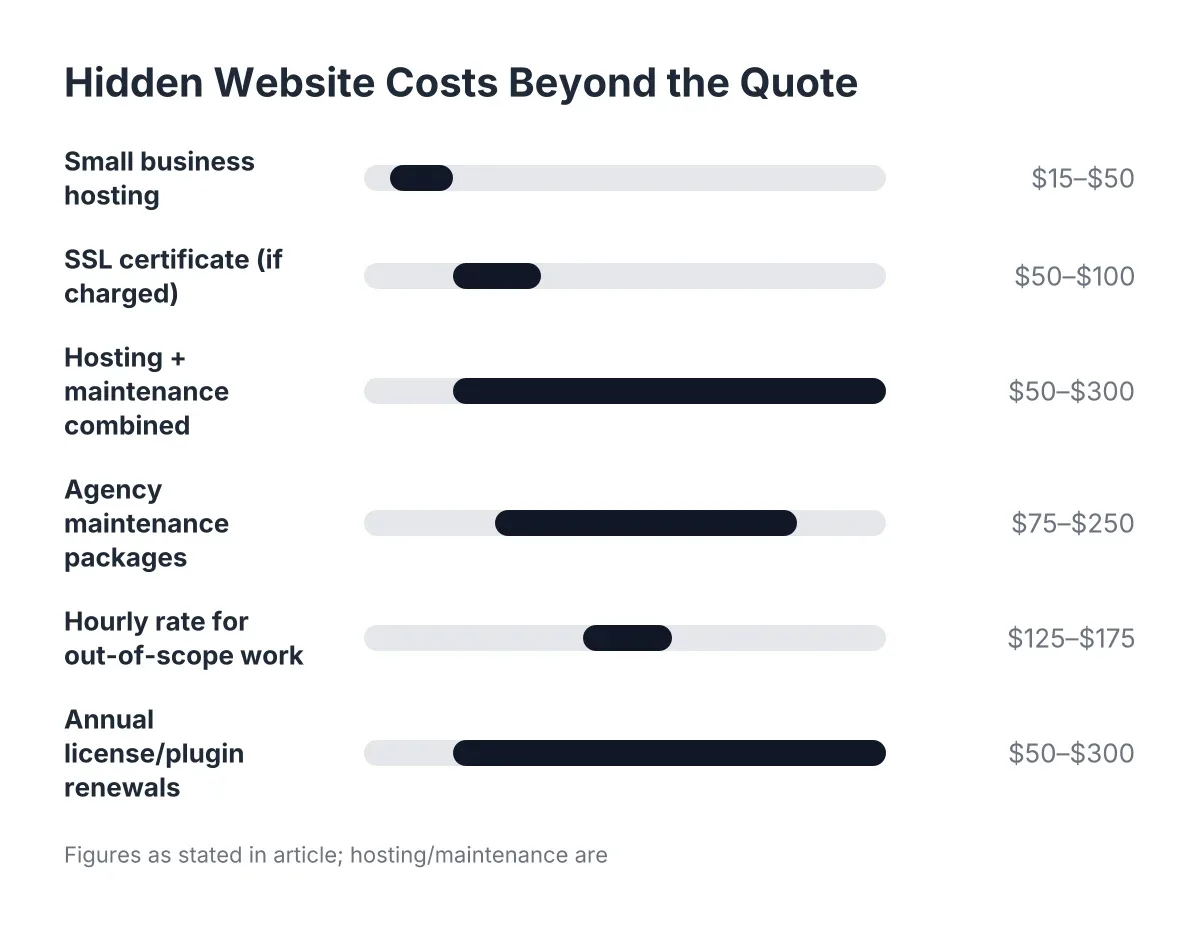
Many agencies quote the design and leave hosting as "client responsibility." That sounds fair until you're the one comparing hosting plans at 10 p.m. on a Tuesday. Budget $15 to $50 per month for decent small business hosting, plus an SSL certificate, which should be free in 2026 but some hosts still charge $50 to $100 a year for it.
Then there's the domain renewal, email hosting if your address matches your domain, and backups. None of these are expensive individually. All of them are your problem if nobody owns them in the contract. Ask one question: "What happens if the site goes down on a Saturday, and who do I call?" If the answer is "your hosting provider," you've found a hidden cost measured in your own hours.
Performance matters here too, not just uptime. According to Google, 79% of shoppers dissatisfied with a site's performance say they are less likely to buy from that site again. Cheap hosting that saves you $20 a month and loses you one plumbing job a quarter is not a savings.
Maintenance, updates, and website maintenance packages
So how much does a website cost per month once it's live? For a local service business in 2026, expect $50 to $300 per month for hosting plus maintenance combined, depending on who manages it. Website maintenance packages from agencies typically run $75 to $250 per month and cover software updates, security patches, backups, and minor edits.
Here's the trap: some vendors quote a low build price and no maintenance, then charge $125 to $175 per hour when something breaks. Suppose a plugin update crashes your contact form and you don't notice for two weeks. You've lost leads you'll never count, and the fix bills at an hourly rate you never agreed to. A flat monthly plan that includes hosting, support, and updates removes that risk entirely; that's the whole logic behind bundling it at a known number like $199 per month.
Content changes and the "that's out of scope" email
Every site needs edits. New service area, updated pricing, a photo of the new truck. Ask the vendor directly: how many content changes per month are included, and what does change number five cost? Agencies that stay vague here are planning to bill you hourly later.
Licenses, plugins, and stock assets
Premium themes, page builders, form tools, and stock photos all carry licenses. Some renew annually at $50 to $300 each. If your vendor built the site on tools licensed to their agency account, you may lose access to those tools the day you leave them. Get it in writing: which licenses does the site depend on, who pays the renewals, and what happens if you switch providers.
Ownership and exit fees
This one stings the most. Some contracts state the agency owns the design, the code, or even the domain until some condition is met. Leaving can mean rebuilding from zero. Before signing, confirm in writing that you own your domain, your content, and your site files, and that there is no fee to export them. A fair vendor answers this in one sentence. A vendor who dodges it is telling you something.
The Hidden Costs in Review Management, and Why They Sting More
Hidden costs in review services hurt more than website surprises because reviews drive revenue directly. According to Exploding Topics, 93% of consumers say online reviews impact their purchase decisions, and Google hosts about 73% of all online reviews. When your review system stalls over a surprise fee, you're not losing a website feature. You're losing trust you can measure in booked jobs.
Per-location, per-user, and per-request pricing
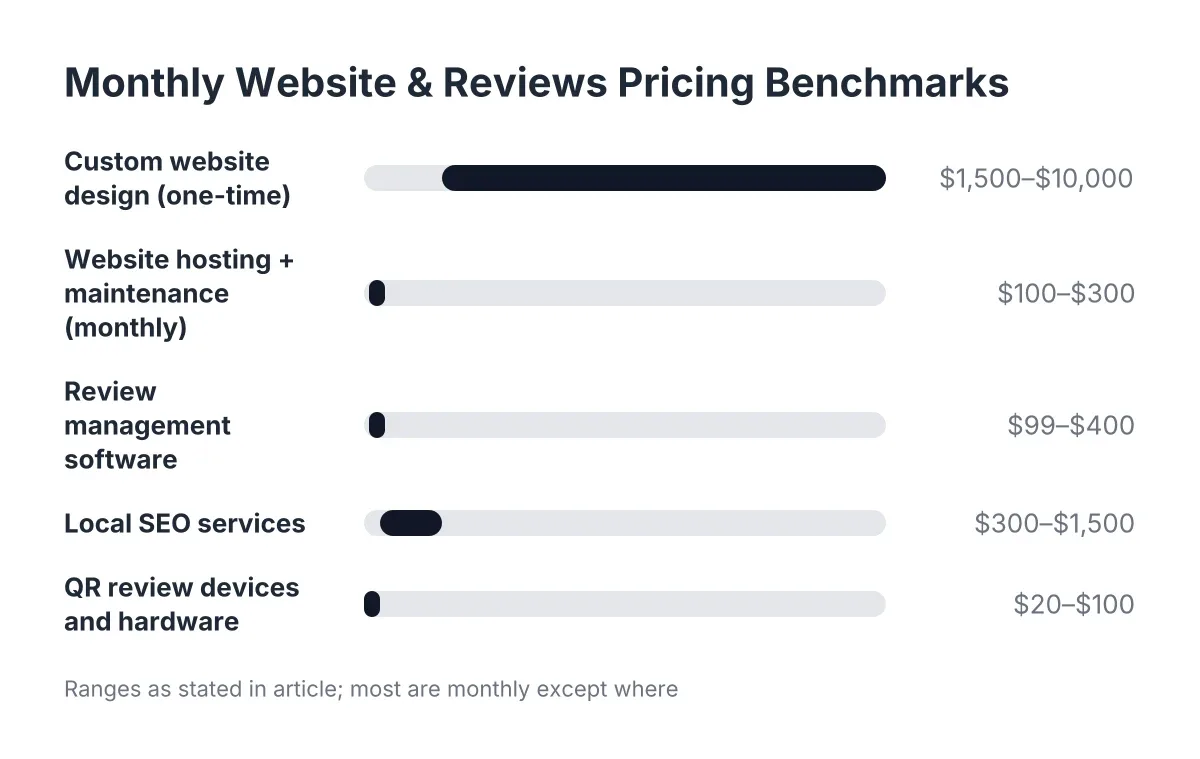
Review management software pricing looks clean on the pricing page: $99, $199, $399 per month. Read the fine print. Many platforms charge per location, so your two-shop auto repair business pays double. Others cap review requests per month, then charge overages. Some charge per user seat, which matters the moment your office manager needs her own login.
A fair reviews plan tells you exactly what Basic, Pro, and Growth tiers include, in plain numbers: how many requests, how many locations, what automation is on or off at each level. If you have to book a sales call to learn what the tiers cost, assume the price flexes based on what they think you'll pay.
Setup fees and integration charges
Connecting review software to your Google Business Profile, your CRM, or your invoicing tool sometimes carries a one-time "implementation fee" of $200 to $500 that never appeared on the pricing page. Ask before you sign: is setup included, and does that include connecting my Google reviews and importing my customer list?
The hardware upsell
QR review devices, the tap-or-scan cards and stands that let a happy customer leave a Google review on the spot, are genuinely useful for trade businesses. The hidden cost shows up when the hardware is cheap but locked to a monthly per-device fee, or when replacement cards cost triple the original. Ask for the all-in device cost over 24 months, not the sticker.
The cost of not responding
One hidden cost has nothing to do with vendors. According to BrightLocal, 88% of consumers say they would use a business that replies to all of its reviews, compared to just 47% for a business that never responds. If your plan collects reviews but response management costs extra, or falls back on you with zero time to do it, you're paying for half a system. Confirm whether responses are automated, assisted, or entirely your job.
Benchmarking Vague Quotes Against Transparent Pricing
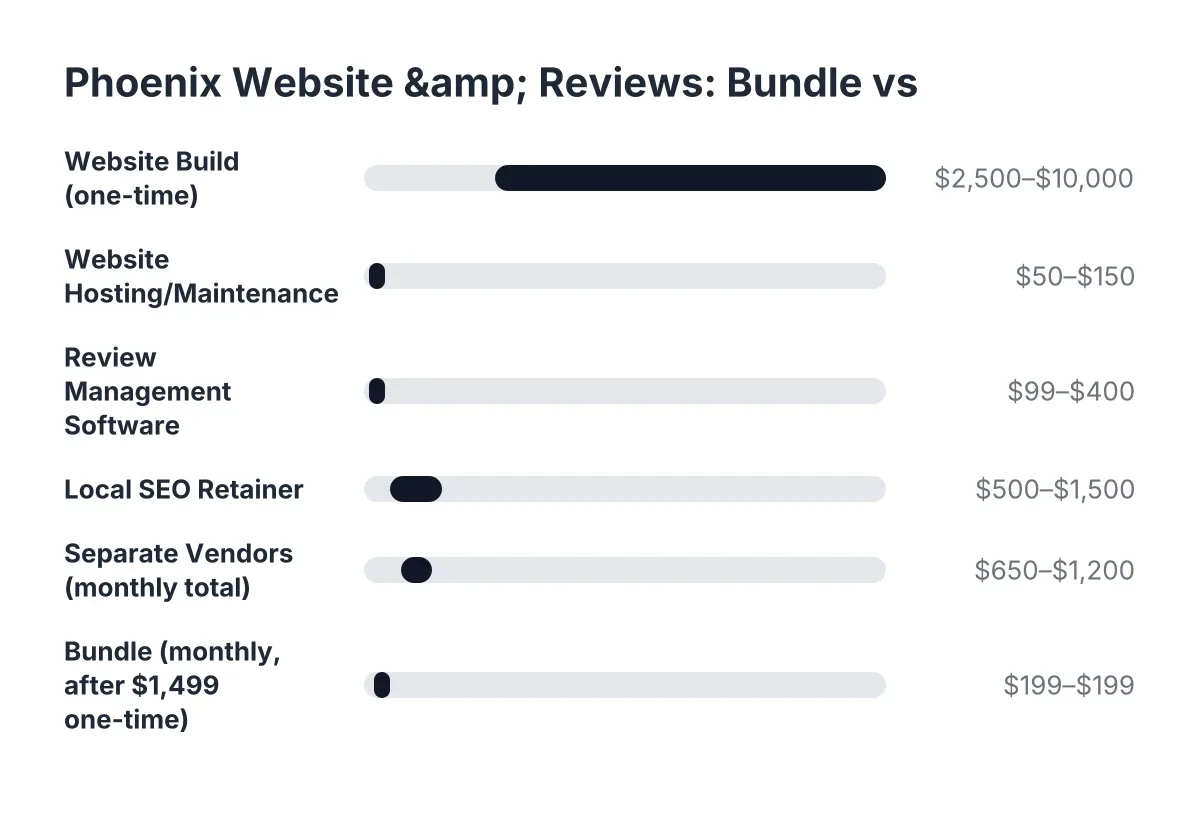
Use a known transparent model as your measuring stick. One real-world benchmark for local service businesses in 2026: $1,499 one-time for a custom website build plus $199 per month covering hosting, support, SEO, and review automation together. Reviews-only plans in the market run $99 to $399 per month. Hold every quote you receive against those numbers and make the vendor explain the difference.
That doesn't mean cheaper is better or pricier is a ripoff. It means the burden of explanation sits with the vendor. If an agency quotes $7,500 for the build and $400 per month, fine, but they should articulate exactly what you get beyond the benchmark: more pages, custom functionality, dedicated account management, something concrete. "Our process is more thorough" is not a line item.
Here's a hypothetical worth running. Say a roofer gets two quotes. Vendor A: $2,000 build, "hosting not included," maintenance hourly, reviews via a third-party tool at $149 per month with a 100-request cap. Vendor B: $1,499 build plus $199 per month, everything bundled. Additionally, vendor A looks cheaper on day one. Price the first year honestly: Vendor A lands around $2,000 plus roughly $300 hosting, plus $1,788 for reviews, plus two or three hourly fixes, call it $4,500 to $5,000, with the roofer coordinating three providers. Vendor B is $3,887, one invoice, one phone number. In that scenario the "cheaper" quote costs more and eats more of the owner's time, which is the one cost nobody invoices.
Monthly versus one-time pricing deserves a quick word too. Pure monthly plans ($150 to $300 per month, no upfront) feel painless but often mean you never own the site; cancel and it vanishes. Pure one-time builds leave you alone the day something breaks. The hybrid, a one-time build you own plus a flat monthly service fee, gives you ownership and ongoing support. That's why it has become the standard structure for local service businesses, and it's the easiest to audit for hidden website vendor fees because everything recurring sits in one visible number.
A Pre-Signing Checklist: Surface Hidden Fees in Web Design Contracts
Before you sign anything, get written answers to these questions. "Written" matters; verbal assurances evaporate when the invoice arrives.
- What is the total first-year cost, including build, hosting, maintenance, licenses, and review software? Ask for one number.
- Who owns the domain, the site files, the design, and the content? What does it cost to export everything if I leave?
- How many content edits per month are included, and what is the hourly rate beyond that?
- Which third-party licenses does my site depend on, and who pays their renewals?
- For review software: what are the limits on requests, locations, and users at my tier, and what do overages cost?
- Is setup included, including connecting my Google Business Profile and importing my customer list?
- Does the plan include help responding to reviews, or just collecting them?
- What is the cancellation policy, notice period, and any early termination fee?
- What exactly does the monthly fee cover, and what common requests fall outside it?
- If the site goes down or the review automation stops sending, who fixes it and how fast?
A vendor who answers all ten quickly and in plain numbers is a vendor you can work with. A vendor who answers three and schedules a call to "walk you through the rest" is showing you how the next two years will feel.
What Fair All-In Pricing Looks Like in 2026
Fair combined website and reviews cost for a local service or trade business in 2026 falls in a knowable range: $1,500 to $5,000 one-time for a custom build, $150 to $350 per month all-in for hosting, maintenance, local SEO basics, and review automation. Reviews-only plans run $99 to $399 per month depending on volume and automation depth. Anything far outside those ranges needs a concrete justification.
Context matters, though. According to BrightLocal, 89% of small and midsize businesses invest in organic SEO, yet only 40% say they have a dedicated business website. Translation: plenty of your competitors are spending money online without owning the one asset that compounds. If your quote covers a site you actually own plus a review engine that runs itself, you're buying something most competitors in your trade still don't have.
One honest caveat: if your business has unusual needs, think online booking with real-time dispatch, e-commerce, or multi-state service areas, standard pricing benchmarks won't map cleanly, and it's worth having an accountant or a technically fluent friend review the contract before you sign. For complex builds, custom quotes are legitimate; vagueness about recurring fees never is.
The Bottom Line on Hidden Website and Review Costs
Hidden costs in website and review services follow one pattern: a sharp number for the part you're excited about, and fog around everything recurring. You beat that pattern by pricing the full first year, demanding written answers to the ten questions above, and benchmarking every quote against a transparent model.
Too many great local businesses lose work to bigger, shittier brands that simply look better online. Don't let a vague contract be the reason you stay invisible or the reason your budget bleeds $150 a month in fees nobody mentioned. You've already made the decision to invest in your online presence. Now make the vendor earn it, line item by line item, before you sign.
If you need web design, Revenue Goblin can help.