Google Review Policy Changes April 2026: What Phoenix, AZ Businesses Need to Know
If you run a local service business, the Google review policy changes rolling out in April 2026 are worth 15 minutes of your attention. Google tightened the rules on how businesses can ask for, display, and manage reviews, and it put real enforcement muscle behind them. For a plumber, roofer, or HVAC company in Phoenix, AZ, your Google reviews are often the single biggest factor in whether a homeowner calls you or the next company on the map. Losing them to a policy violation, even temporarily, hurts.
This guide walks through what actually changed in April 2026, what you need to stop doing, what you can keep doing, and how to protect the review profile you have worked years to build. No legal jargon, no scare tactics, just the practical version for an owner who answers the phone with one hand and runs the business with the other. Understanding how to avoid a review gating violation is essential to maintaining your profile's integrity.
Why These Changes Matter for Local Businesses in Phoenix, AZ
Google is the review platform that matters. According to Exploding Topics, Google hosts about 73% of all online reviews, more than six times as many as its nearest competitors combined. When Google changes its rules, it changes the rules for everyone.
The stakes are not abstract. Nearly all consumers, 93% according to Exploding Topics, say online reviews impact their purchase decisions. In a competitive market like Phoenix, AZ, where dozens of HVAC and roofing companies compete for the same summer emergency calls, your review count and rating are often the tiebreaker.
Here is the frustrating part. Too many great businesses lose to bigger, shittier brands simply because the bigger brand has 400 reviews and the great business has 12. The April 2026 policy changes do not fix that gap, but they do change how you are allowed to close it. Get the rules wrong and Google can suspend reviews on your profile, remove reviews in bulk, or attach a public warning to your listing. Get them right and the playing field tilts back toward businesses that actually do good work.
What Are the Key Changes in the Google Review Policy for April 2026?
The April 2026 update to Google's review policy centers on three things: harder enforcement against incentivized and gated reviews, new public-facing penalties for businesses caught manipulating reviews, and expanded AI detection of fake or coordinated review activity. Google also clarified rules around how businesses solicit reviews, including QR codes and automated review requests.
Let's break each one down in plain English.
Stricter enforcement on incentivized reviews
Offering anything of value in exchange for a review has been against the rules for years. What changed in 2026 is enforcement. Google's systems now flag patterns that suggest incentives, such as sudden bursts of five-star reviews with similar phrasing, reviews clustered right after a promotion, or language in the review itself that mentions a discount or giveaway.
This includes the gray areas owners ask about constantly:
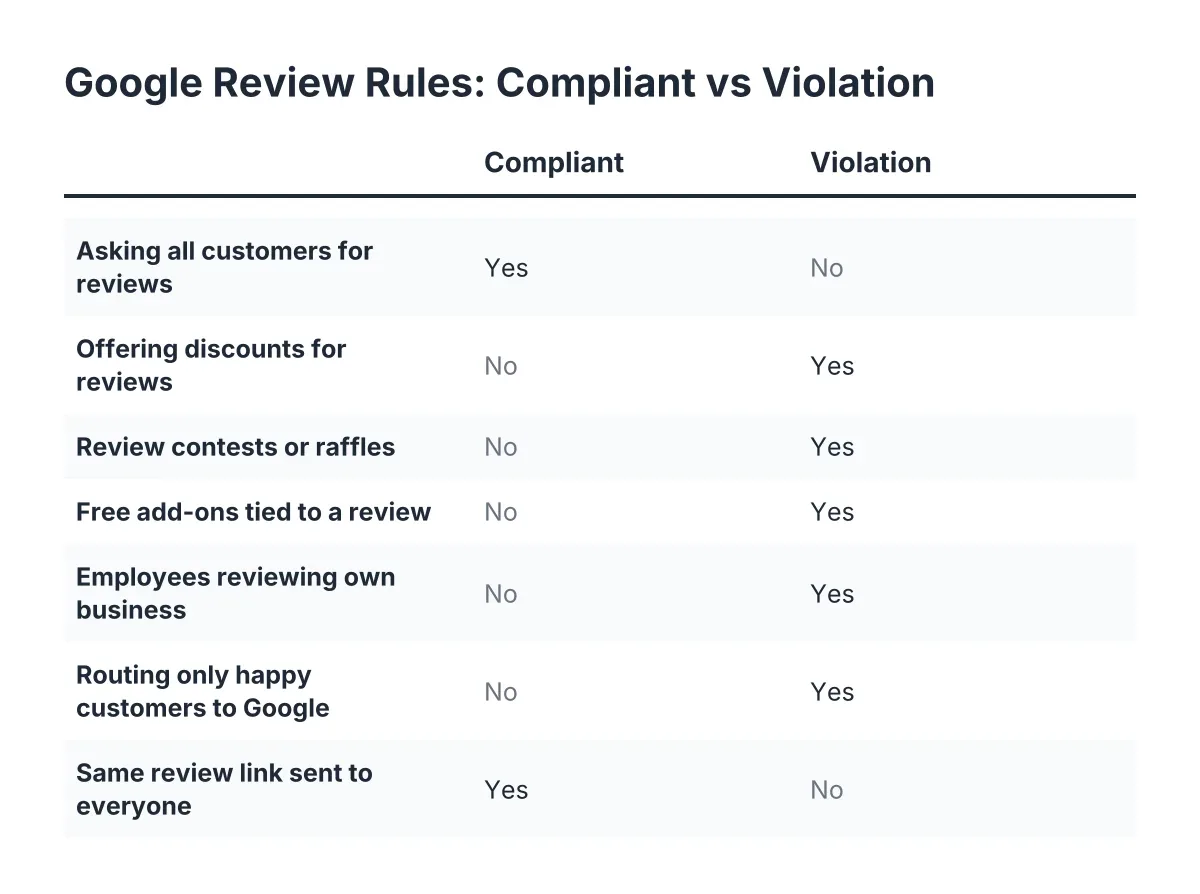
- Discounts for reviews. Prohibited, even if you do not require a five-star rating.
- Review contests and raffles. Prohibited. "Leave a review to enter" counts as an incentive.
- Free add-ons or upgrades. Prohibited if tied to leaving a review.
- Employee reviews. Prohibited. Your staff, your family, and you cannot review your own business.
- Asking happy customers to leave a review. Allowed, as long as you ask everyone and offer nothing in return.
That last one matters. Asking for reviews is still completely fine. The policy targets payment and pressure, not the ask itself.
Review Gating Violations: What Changed
Review gating means filtering customers before sending them to Google. For example, a survey that asks "How was your service?" and only routes happy customers to the Google review page while routing unhappy ones to a private feedback form. Google has prohibited this since 2018, but the April 2026 changes made gating a specifically flagged violation with defined penalties.
If your current review tool pre-screens customers by sentiment before showing the Google link, it puts your profile at risk. The compliant approach sends every customer the same review invitation and the same link. You can still ask for private feedback separately; you just cannot use it as a filter in front of the Google ask. A review gating violation can result in suspension or removal of reviews from your profile.
Public warnings and review suspensions
This is the change with teeth. Businesses caught with fake, incentivized, or gated reviews can now face visible consequences on their profile, including temporary blocks on new reviews and public notices that suspicious activity was detected. For a local service business, a warning label on your Google Business Profile is worse than having fewer reviews. It tells every homeowner comparing three quotes that something is off.
Expanded AI detection of fake and coordinated reviews
Google's detection systems now analyze reviewer behavior across accounts, locations, and time. A review written from an account that has never reviewed anything in Arizona, posted minutes after nine similar reviews, gets flagged automatically. The upside for honest businesses: competitors buying fake five-star reviews are getting caught at a much higher rate, and fake negative reviews aimed at you are easier to get removed.
What You Should Stop Doing Right Now
If any of these sound familiar, change course before Google's systems notice. None of these require bad intent; plenty of owners picked up these habits from a marketing company or a Facebook group without knowing they violate policy.
- Stop offering anything for reviews. No gift cards, no discounts, no entries into a drawing. If a past promotion is still visible on your website or social media, take it down.
- Stop filtering customers before the review ask. If your software asks for a star rating first and only shows the Google link to four- and five-star responses, that is gating.
- Stop reviewing your own business. Delete any reviews from owners, employees, or immediate family if you can, and do not replace them.
- Stop bulk-requesting from old customer lists all at once. A profile that averages one review a month and suddenly gets 30 in a week looks like manipulation, even when every review is real. Spread requests out.
- Stop buying reviews, obviously. If a vendor promises "guaranteed five-star reviews," they are selling you a suspension.
One honest caveat: Google's enforcement is automated and imperfect. Legitimate businesses occasionally get caught in false positives, and the appeals process takes patience. If your profile gets suspended and you believe it was a mistake, document your review collection process before you appeal; if the situation involves defamation or legal threats, talk to an attorney rather than relying on a blog post.
What You Can Still Do, and Should Do More Of
The April 2026 rules did not make review collection harder for honest businesses. In some ways they made it easier, because the shortcuts your competitors used just got riskier. Everything below remains fully compliant.
Ask every customer for a review. In person, by text, by email, or with a QR code on an invoice or a physical device at checkout. QR review devices are explicitly fine as long as they link directly to your review page without filtering or incentives.
Automate your review requests. Sending an automated text after every completed job is compliant and effective. The policy cares about what the message says and who receives it, not whether a human pressed send. The rule of thumb: ask everyone, offer nothing, link straight to Google.
Respond to every review, good and bad. This is the most underused trust signal in local business. According to BrightLocal, 88% of consumers say they would use a business that replies to all of its reviews, compared to just 47% for a business that never responds. That gap is bigger than the gap between a 4.9 and a 4.6 rating.
Report reviews that violate policy. Fake reviews, reviews from someone who was never a customer, reviews containing profanity or personal attacks, and reviews left by competitors all qualify for removal. The 2026 detection improvements mean legitimate removal requests get processed faster than they used to.
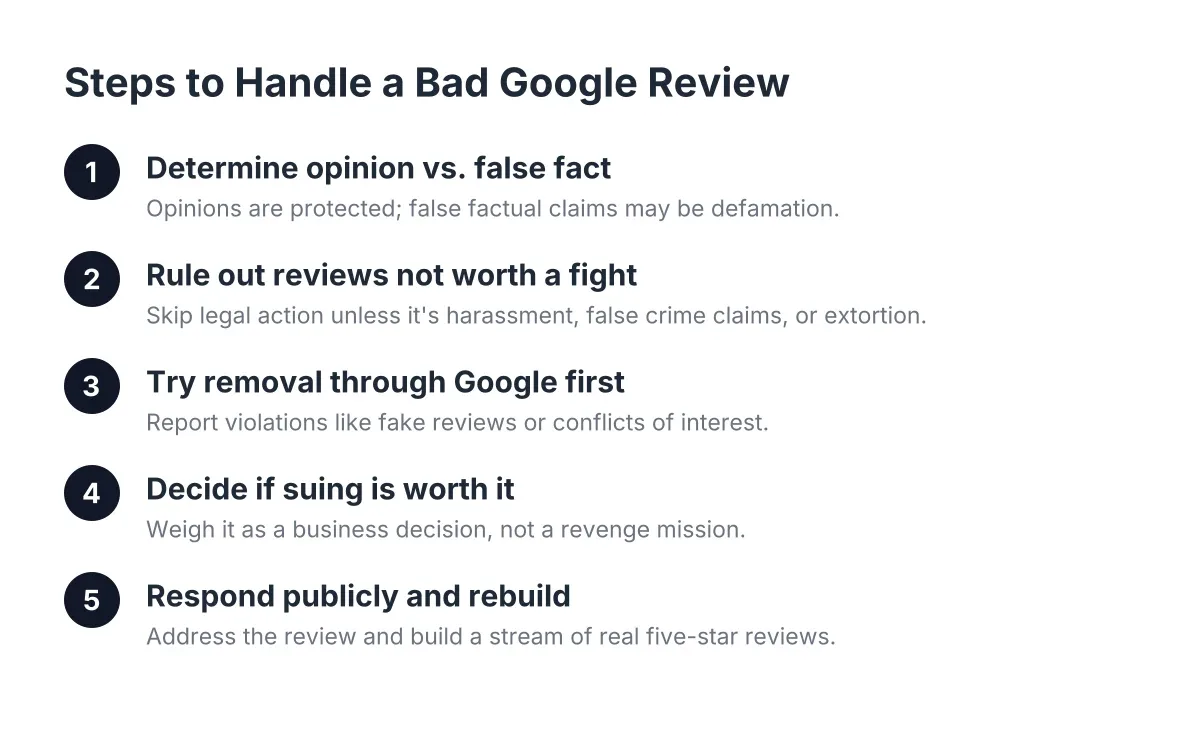
Can Companies Get Rid of Bad Google Reviews?
Companies can get negative Google reviews removed only when the review violates Google's content policies; they cannot remove a review simply because it is critical or unfair. Removable violations include fake reviews, spam, conflicts of interest, off-topic rants, harassment, and reviews from people who never used the business. Honest one-star reviews from real customers stay.
This is the question every owner asks after a rough review, so here is the practical process. Open the review in your Google Business Profile, select the option to report it, choose the specific policy violation, and wait. Decisions typically take several days to a few weeks. If the first report fails, you can escalate through the Business Profile support channels with evidence, such as proof the reviewer was never a customer.
Suppose a Phoenix, AZ pool service company gets a one-star review from a name they do not recognize, with no job in their records and a complaint that describes a different company's work. That review is a strong removal candidate under the conflict-of-interest and off-topic rules. On the other hand, a real customer who felt the tech showed up late and left a two-star review is not removable. The right move there is a calm, professional public reply that shows the next 50 readers how you handle problems.
Do not reply with legal threats or accusations. Beyond being a bad look, aggressive responses to reviewers can create actual legal exposure, and they signal to prospects that criticism makes you volatile.
Is It Illegal to Leave a Bad Review on Google?
Leaving a bad review on Google is not illegal when the review reflects the customer's honest opinion or truthful account of their experience. Negative reviews are protected speech in the United States. A review only crosses into legal territory when it contains knowingly false statements of fact that damage the business, which is defamation.
Business owners should understand this from both sides. As a consumer, you can say "the crew left debris in my yard and never called back" if that is what happened. As a business, you cannot sue your way out of honest criticism, and in many states, including Arizona, anti-SLAPP laws penalize lawsuits filed to silence legitimate speech.
Can a company sue you over a Google review?
A company can sue over a Google review, but the suit only has a realistic chance if the review contains false factual claims rather than opinions. "Worst plumber in Phoenix" is opinion and protected. "They stole my credit card number" is a factual claim, and if it is false, it could support a defamation case. Lawsuits over reviews are expensive, slow, and usually generate more bad press than the review itself. For owners, the practical answer is almost always a public response and a removal request, not a lawyer.
How often can you leave a Google review for a company?
Google allows one review per account per business location. A customer can edit or update their existing review after a new experience, but they cannot stack multiple reviews on the same profile. For businesses, this means your review count grows one customer at a time, which is exactly why a consistent, automated ask after every job beats an occasional push.
How the Google Review Policy Changes Affect Your Review Strategy
The practical effect of the April 2026 google review policy changes is simple: consistency beats bursts, and compliant automation beats manual hustle. The businesses that win under the new rules are the ones with a steady, repeatable system that asks every customer, every time, with no filters and no incentives.
Here is an illustrative scenario. Say a two-truck electrical company in Phoenix, AZ completes about 60 jobs a month. Under an old-school approach, the owner remembers to ask for reviews when things slow down, fires off 40 requests to past customers in one weekend, and gets a suspicious-looking spike. Under a compliant system, every completed job triggers a text within an hour, while the experience is fresh. If even 15% of customers follow through, that is nine new reviews a month, 100-plus a year, arriving at a natural pace that Google's detection systems read as organic. In that scenario, the steady business passes the burst business within six months and never triggers a flag.
The same logic applies to responses. Block 15 minutes twice a week to reply to every new review. Thank the positive ones specifically, mentioning the job or neighborhood when you can. Address the negative ones with facts and an offer to make it right offline. Consumers notice; BrightLocal found that 91% of consumers say local branch reviews affect their overall perception of big brands, and the perception effect is even more direct for a small operation where the owner's name is on the truck.
One more number worth sitting with. According to BrightLocal, only 35% of small and midsize businesses have a Google Business Profile at all. If you have a claimed, verified profile with a working review system, you are already ahead of most of the market before the first five-star review lands.
A Compliance Checklist for the April 2026 Rules
Run through this list once, fix what fails, and your profile is in good shape under the current Google review policy. Most owners can complete the whole audit in under an hour.
- Remove any website banners, social posts, or in-store signs offering discounts, gifts, or contest entries for reviews.
- Check your review software for gating. If it filters by sentiment before showing the Google link, replace it or turn that feature off.
- Confirm your review request messages ask for honest feedback and link directly to your Google review page.
- Delete or stop soliciting reviews from employees, family, and business partners.
- Spread review requests across the month instead of batching old customer lists.
- Reply to every review on your profile, starting with the most recent 10.
- Report any reviews that clearly violate policy, with documentation ready if you need to escalate.
- Verify your Google Business Profile information is accurate, since profile quality factors into how Google weighs flagged activity.
The Bottom Line for Phoenix, AZ Service Businesses
The April 2026 google review policy changes punish shortcuts and reward systems. If your review strategy was built on incentives, gating, or bursts, it is now a liability. If it is built on asking every customer promptly, responding to everything, and letting real work generate real reviews, nothing about these changes threatens you. They actually help, because the competitors inflating their numbers are the ones getting flagged.
For a solo operator or small team in Phoenix, AZ, the move is not complicated. Set up one compliant, automated ask that fires after every job. Reply to reviews twice a week. Report the fakes. Then get back to the work that earns the five stars in the first place. The rules changed; the fundamentals did not.
If you need web design, Revenue Goblin can help.