Payment Processing Terms Explained: A Plain-English Glossary
If you run a small business and you've ever stared at a processor quote wondering what half the words mean, this payment processing glossary is for you. Every entry here defines one term in plain English, then tells you why it matters when you're comparing providers or reading your monthly statement. Use it to decode quotes line by line, ask sharper questions, and spot the fees that quietly eat your margin. No jargon explained with more jargon.
- Payment Processor: the company moving the money
- Merchant Account: where your card money lands first
- Payment Gateway: the online checkout messenger
- Interchange Fee: the card network's base cut
- Interchange-Plus Pricing: transparent cost-plus-markup pricing
- Flat-Rate Pricing: one simple percentage for everything
- Tiered Pricing: the murky three-bucket pricing model
- Monthly Minimum: a fee for not processing enough
- Chargeback: a customer disputes a charge
- PCI Compliance: the card security rulebook
- Card-Present vs. Card-Not-Present: swiped in person vs. typed online
- Authorization and Settlement: the approval, then the actual money
- Batch Processing: closing out the day's sales
- ACH Payment: bank-to-bank transfer, no card
- Recurring Billing: automatic charges on a schedule
- POS System: the hardware and software that takes payment
- Effective Rate: what you actually pay, all-in
- Early Termination Fee: the cost of leaving a contract
Core Terms in Payment Processing Glossary
Before the pricing terms make sense, you need to know who touches your money and in what order. These are the foundational entries in this payment processing glossary.
Payment Processor
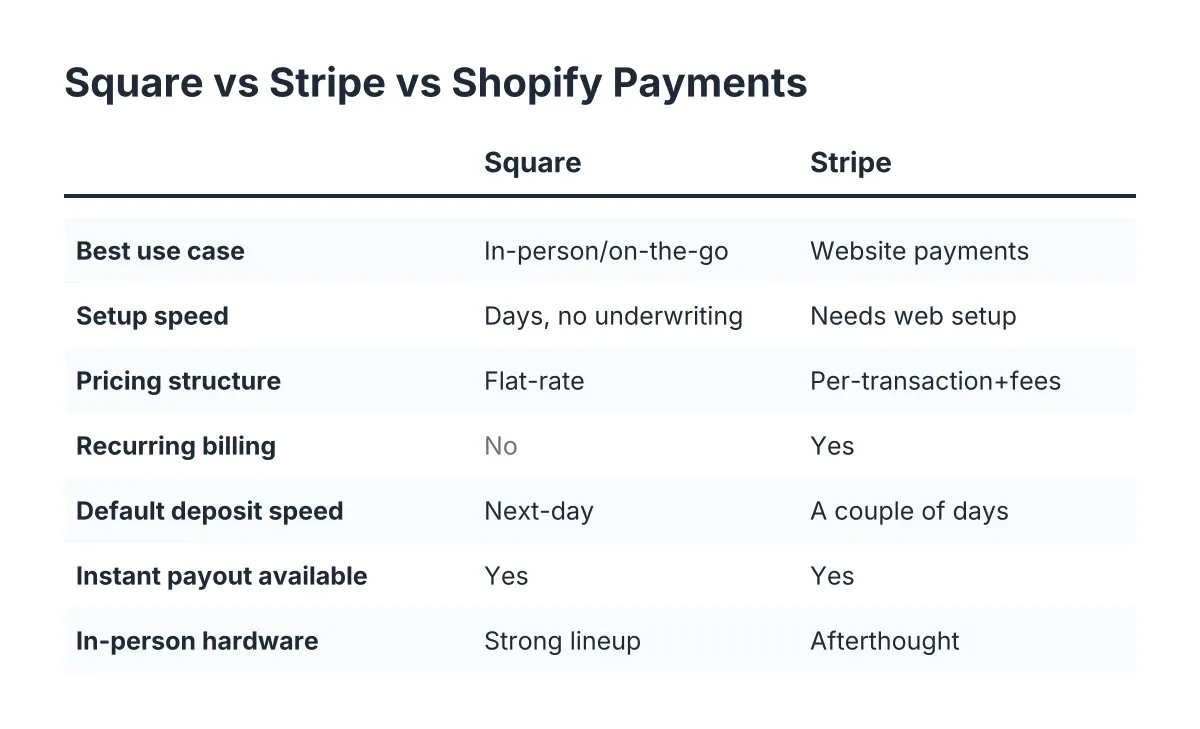
A payment processor is the company that moves money from your customer's card to your bank account. It talks to the card networks, checks that the card is good, and routes the funds. Every quote you get comes from one of these companies or a reseller of one. If you're weighing options, our comparison of Square, Stripe, and Shopify Payments for local businesses breaks down how the big names stack up for small shops.
Merchant Account
A merchant account is a special bank account where your card sales land before they transfer to your regular business checking account. Some providers give you a dedicated one; others pool you into a shared account, which is faster to set up but gives them more power to freeze funds. Ask which kind you're getting. The answer affects how fast you get paid and how much paperwork you fill out upfront.
Payment Gateway
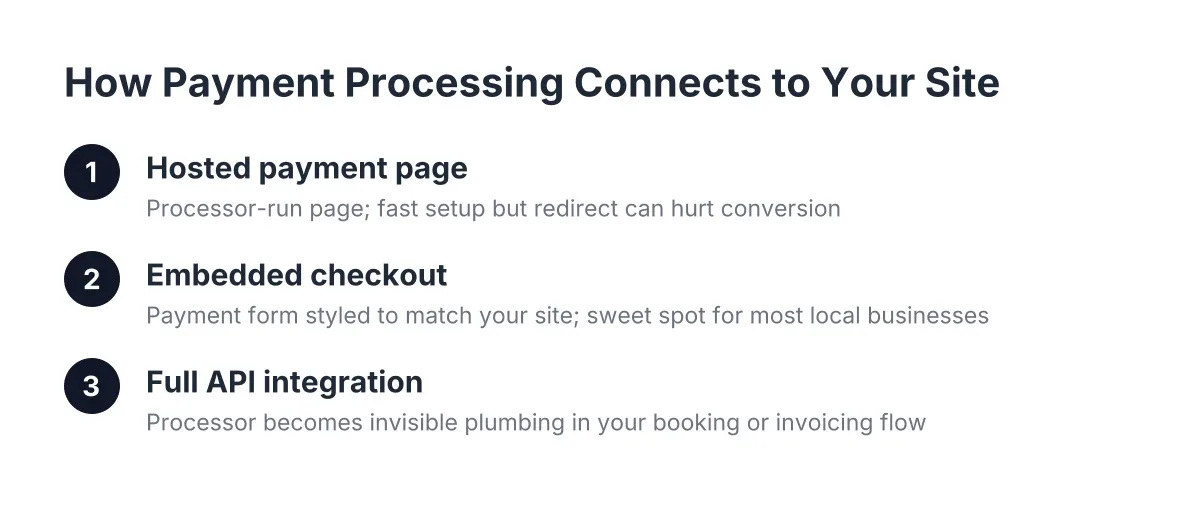
A payment gateway is the software that securely carries card details from your website's checkout to the processor. Think of it as the armored courier between your "Buy Now" button and the bank. If you sell online, you need one, and some processors bundle it while others charge for it separately. How your gateway connects to your site affects both cost and customer experience, which we cover in how payment processing integrates with a custom website.
POS System
A POS system, short for point of sale, is the combination of hardware and software you use to take payments in person. That could be a full register setup or a small card reader paired with a phone. Providers often lease or sell POS hardware alongside processing, so check whether equipment costs are baked into your quote or billed separately. A cheap rate with expensive mandatory hardware isn't a cheap rate.
How the Money Actually Moves
These terms describe what happens between the tap and the deposit. Knowing them helps you understand why your money shows up when it does.
Authorization and Settlement
Authorization is the instant approval that confirms a card is valid and has funds; settlement is the later step where the money actually moves to you. A customer's card can be authorized at noon, but you typically don't see the cash until settlement, often one to two business days later. When a provider advertises "fast deposits", they mean faster settlement. Ask for the specific timeline in writing.
Batch Processing
Batch processing means your processor collects all your authorized transactions and settles them together, usually once a day. Most systems "close the batch" automatically each night. Why care? If a batch doesn't close on time, your deposit slips a day. Some providers also charge a small per-batch fee, so look for it on your statement.
ACH Payment
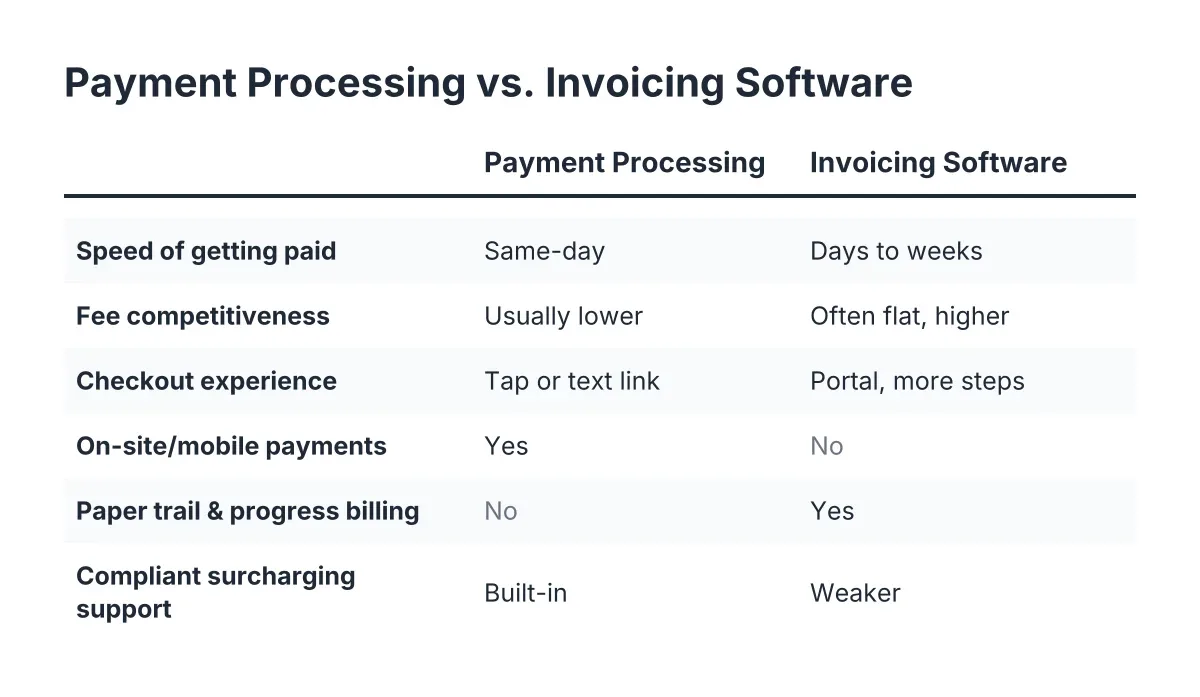
An ACH payment is a direct bank-to-bank transfer that skips the card networks entirely. Because no card network takes a cut, ACH usually costs less per transaction than cards, though it moves slower. For large invoices, like a contractor billing a big job, ACH can save real money. If your work is invoice-heavy, see our breakdown of payment processing software vs. invoicing software.
Recurring Billing
Recurring billing is automatically charging a customer's stored payment method on a schedule, like monthly service plans or memberships. It smooths your cash flow and spares customers from remembering to pay. Not every processor supports it well, so if subscriptions matter to your business, ask how stored cards are handled and what happens when one expires.
Card-Present vs. Card-Not-Present
A card-present transaction happens when the physical card is tapped, dipped, or swiped in front of you; card-not-present means the number was typed in online or over the phone. Card-not-present transactions carry more fraud risk, so processors charge more for them. If you sell both in person and online, expect two different rates on your statement, not one. A provider quoting you a single number for both is glossing over something.
Pricing, Fees, and Fine Print in Payment Processing
This is where quotes get slippery. Modern payment processing has layers of fees, and the pricing model a provider picks tells you a lot about how honest the quote is.
Interchange Fee
An interchange fee is the non-negotiable base fee set by the card networks and paid to the customer's card-issuing bank on every transaction. Every processor pays it; nobody escapes it. What varies is the markup your processor adds on top. When a salesperson promises to "beat interchange", be skeptical, because that's like promising gas below the refinery's cost.
Interchange-Plus Pricing
Interchange-plus pricing means you pay the actual interchange fee plus a fixed, disclosed markup to your processor. It's the most transparent model because you can see exactly what the processor keeps. It takes a little more effort to read the statement, but you'll know when you're being gouged. For most established businesses, it's worth asking for by name.
Flat-Rate Pricing
Flat-rate pricing means you pay one fixed percentage (sometimes plus a small per-transaction amount) on every sale, regardless of card type. It's simple and predictable, which is why popular small-business processors use it. The trade-off: on low-cost debit cards you often overpay compared to interchange-plus. Simple is great when you're starting out; it gets expensive as your volume grows.
Tiered Pricing
Tiered pricing means your processor sorts transactions into buckets, usually "qualified", "mid-qualified", and "non-qualified", and charges a different rate for each. The catch: the processor decides which bucket each sale falls into, and the advertised rate is usually just the cheapest tier. This is the model most likely to produce a statement you can't decipher. If a quote leads with one shiny low number and buries the tiers, ask for interchange-plus instead.
Monthly Minimum
A monthly minimum is a fee you pay if your processing fees don't reach a set threshold in a given month. Low-volume or seasonal businesses get hit hardest. If your sales swing with the seasons, ask directly whether a minimum applies and what it costs in your slow months.
Effective Rate
Your effective rate is your total monthly processing cost divided by your total monthly sales, expressed as a percentage. It's the single most honest number in this whole subject because it includes every fee, not just the advertised rate. Calculate it from a real statement before you sign anything new. If a provider's quoted rate and your actual effective rate are far apart, you've found the fine print.
Early Termination Fee
An early termination fee is a penalty for canceling your processing contract before its term ends. Some contracts even include "liquidated damages", which can mean paying the fees the processor expected to earn for the rest of the term. Month-to-month agreements exist and are worth asking for. Any provider confident in their service shouldn't need to lock the door behind you.
Risk and Rules
Chargeback
A chargeback is when a customer disputes a charge with their bank and the money is pulled back out of your account while the dispute is reviewed. You lose the sale, usually pay a dispute fee, and have to submit evidence to fight it. Too many chargebacks can get your account flagged or closed. Clear receipts, recognizable billing descriptors, and good communication prevent most of them.
PCI Compliance
PCI compliance means following the card industry's security standards for handling cardholder data. Every business that accepts cards must comply, usually by completing an annual self-assessment questionnaire. Watch for two line items on statements: a PCI compliance fee and a PCI non-compliance fee, charged when you haven't completed the paperwork. The second one is avoidable, so don't pay it out of neglect.
Using These Terms
That's what this payment processing glossary gives you: the vocabulary to read a quote line by line instead of taking the headline rate on faith. Pull your last statement, calculate your effective rate, and ask any provider to explain every fee in terms you just learned. If they can't explain it plainly, that tells you something too. And if you'd rather have a second set of eyes on it, a payment processing review does exactly that.
If you need web design, Revenue Goblin can help.