Local SEO — Complete Guide
Local SEO decides whether your business shows up when someone nearby searches for what you sell, or whether a competitor gets the call instead. If you have ever typed your own service into Google and scrolled past three rivals before finding yourself, this guide explains why that happens and how to fix it. We break down the exact levers that move local rankings: your Google Business Profile, on-page optimization, local schema markup, citations, and reviews. Beyond that, we show you which fixes you can handle yourself and where professional help actually pays off. No jargon, no vague promises, just the same playbook we build into every website we ship.
What You'll Find in This Guide
Prefer to have a pro handle it? Local SEO is one call away.
Why Your Business Isn't Showing Up on Google
Most owners assume Google is ignoring them because their business is small or new. In practice, the reasons are usually more fixable than that. Google ranks nearby businesses on three broad factors: relevance, distance, and prominence. Relevance means Google understands what you do. Distance means you are close to the searcher. Prominence means Google trusts that you are legitimate and well regarded.
You cannot control distance. However, you have direct control over the other two, and that is where most businesses fall short. The gaps tend to look like this: no website or a thin one-page site, an unclaimed or half-finished Google Business Profile, inconsistent business information across the web, and a handful of old reviews with no responses.
The numbers back this up. According to BrightLocal, 89% of small and midsize businesses invest in organic search optimization, yet only 40% say they have a dedicated business website. Even more surprising, BrightLocal found that only 35% of small and midsize businesses have a Google Business Profile at all. That means most of your local competitors are leaving the single most powerful free ranking tool untouched. As a result, the bar for outranking them is lower than you think.
The Map Pack vs. Regular Search Results
When you search for a nearby service, Google shows two distinct result types. The map pack sits at the top: a map with three highlighted businesses, their ratings, and their contact details. Below that come the traditional blue-link results. These two lists run on related but separate signals. Your Google Business Profile drives the map pack. Meanwhile, your website drives the organic listings underneath.
This matters because fixing one without the other leaves money on the table. For example, a business with a great website but a neglected profile misses the map pack, where most calls and direction requests happen. Conversely, a strong profile with no real website behind it struggles to hold rankings once competitors invest. If you want a sense of what closing both gaps costs, our guide to local SEO services pricing walks through the honest math.
The Ranking Levers That Actually Move Local Search Results
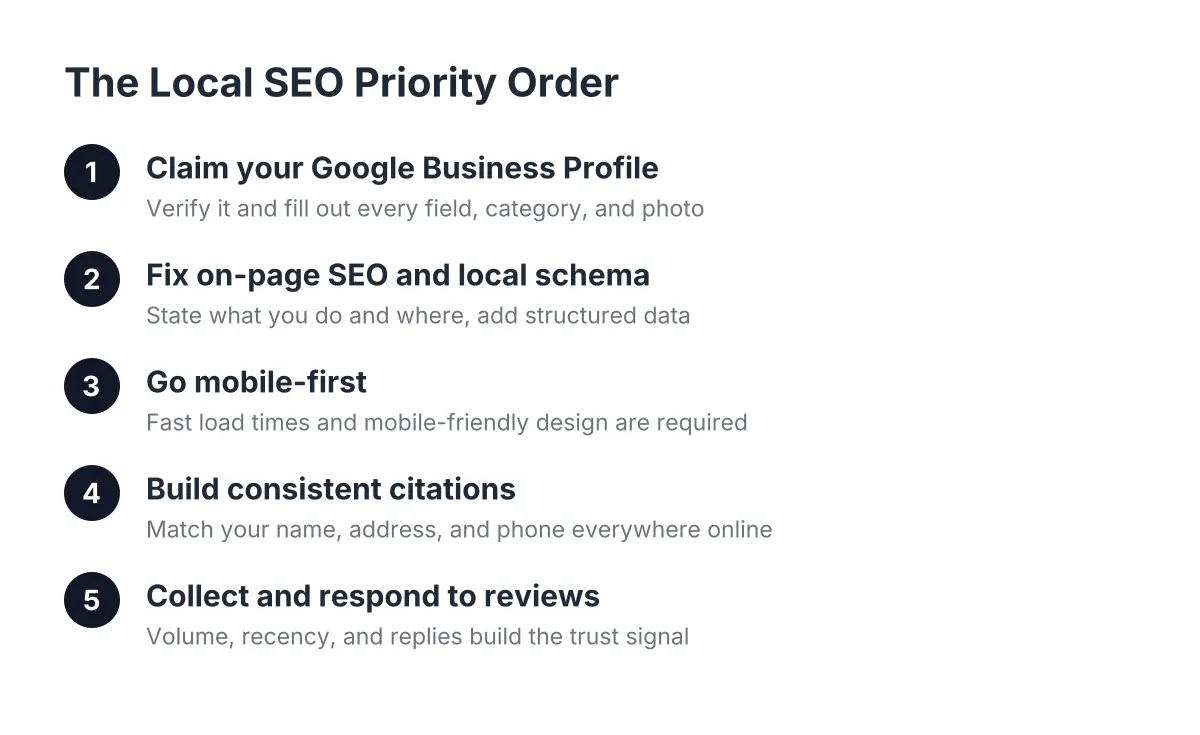
Agencies love to make local search sound mysterious. It is not. A small set of levers does most of the work, and you deserve to know exactly what they are. These are the same levers we bundle into every site we build, so consider this a look under the hood.
Local SEO for Google Business Profile Optimization
Your Google Business Profile is your storefront on Google Maps and in the map pack. Optimizing it starts with the basics: claim it, verify it, and complete every field. Choose your primary category carefully, because it carries more ranking weight than almost anything else on the profile. Then add secondary categories, your service area, hours, photos, and services with descriptions.
Beyond setup, treat the profile like a living channel. Post updates, answer the questions people submit, and upload fresh photos regularly. Google rewards active profiles because activity signals a real, operating business. A simple monthly checklist covers it: confirm hours are accurate, add two or three new photos, publish one post, and respond to every new review.
On-Page Optimization for Local SEO and Search Intent
Your website tells Google what you do and where you do it. Each core service deserves its own page with a clear, descriptive title, a heading that names the service and the city, and genuinely useful content about how you work. Additionally, your name, address, and phone number should appear consistently on the site, matching your Google profile exactly.
Speed and mobile experience matter too. Most nearby searches happen on phones, so a slow or clunky mobile site bleeds both rankings and customers. This is why we build mobile-first by default rather than treating it as an add-on.
Local Schema Markup
Schema markup is structured code that labels your business information for search engines. To put it simply, it translates your site into a language Google reads with certainty instead of guessing. LocalBusiness schema tells Google your exact name, address, phone, hours, service area, and review data. It takes minutes to implement correctly and removes ambiguity that can hold rankings back. Most small business sites skip it entirely, which makes it a quiet competitive edge.
Reviews, Citations, and the Trust Signals Google Rewards
Rankings get you seen. Trust gets you chosen. Fortunately, the same signals that persuade customers also feed Google's prominence factor, so this work pays off twice.
Why Reviews Carry So Much Weight
Google hosts about 73% of all online reviews, more than six times as many as its nearest competitors combined, according to Exploding Topics. That concentration means your Google reviews are not just social proof. They are ranking fuel for the map pack and often the deciding factor when a searcher compares three businesses side by side.
Volume and recency both matter, but responses matter more than most owners realize. BrightLocal found that 88% of consumers say they would use a business that replies to all of its reviews, compared to just 47% for one that never responds. In other words, simply answering reviews nearly doubles your appeal. Reviews also shape perception at every scale: 91% of consumers say local branch reviews affect their overall view of even big brands, per BrightLocal. If national chains live and die by local reviews, so do you.
The hard part is consistency. Asking every happy customer for a review, at the right moment, without awkwardness, is exactly why we built review automation and QR review devices into our packages. Set the system up once, and the requests go out on their own.
Citations and Directory Listings
Citations are mentions of your business name, address, and phone number on other websites: directories, industry associations, chambers of commerce, and data aggregators. Consistency is the whole game here. If your address reads "123 N. Main St." in one place and "123 North Main Street Suite B" in another, Google's confidence in your data drops, and your prominence suffers with it.
Start with the major platforms, then move to industry-specific and local directories. Afterward, audit your existing listings and fix mismatches, especially if you have moved or changed phone numbers. It is tedious work, but it is one-time-heavy and maintenance-light. For businesses in our area, this citation cleanup is a standard part of our Phoenix local SEO service, because rankings stall without it no matter how good the website is.
Putting the Signals Together
None of these levers works in isolation. A polished profile with no reviews looks suspicious. Great reviews pointing to a broken website lose the sale at the last step. The businesses that dominate local search treat visibility as one connected system: website, profile, schema, citations, and reviews all telling Google and customers the same consistent story. That is the standard to aim for, whether you build it yourself or bring in help.
Ready to Get Started?
You now know the levers that actually move local rankings, and none of them requires magic. If you would rather run your business than manage schema markup and review requests, we build all of it into one integrated package: custom website, local SEO, and automated reviews working together. Reach out and we will show you exactly where your online presence stands today and what it would take to make it impossible to ignore.