Local Business Marketing — Complete Guide
Marketing a local business used to mean a phone book listing and word of mouth. Now your customers judge you on a Google search, a review score, and a website they load on their phone before they ever call. This guide covers local business marketing as a complete system: your website, your search visibility, your reviews, and the strategy that ties them together. You'll learn why piecemeal tactics fail, how to build trust that converts searchers into bookings, and how to decide between doing it yourself, hiring in-house, or working with an agency. If you want more customers without guessing which tactic to try next, start here.
What You'll Find in This Guide
Why Local Business Marketing Works as a System, Not a Grab Bag of Tactics
Most small business owners approach marketing like a to-do list: run ads, post on social media, update the website. Each tactic gets scattered attention with minimal results. The problem isn't effort—it's the lack of a system tying the pieces together.
Effective local business marketing has three connected layers. First, get found in local search results and Google Maps. Second, earn trust fast through reviews, photos, and a professional web presence. Third, convert visitors into customers with a clear path to call, book, or buy.
The system matters more than any single tactic. A great ad sending people to a slow website wastes money. A beautiful website with no reviews sits invisible. Each layer feeds the others: reviews improve search rankings, better rankings drive traffic, and a stronger site converts that traffic into customers who leave more reviews. The flywheel only spins when all three parts connect.
The data backs this up. According to BrightLocal, 89% of small and midsize businesses invest in organic SEO, yet only 40% have a dedicated business website—meaning most owners pay to attract searchers they have nowhere good to send. That gap is your competitive advantage, because competitors likely run partial systems.
Your Google Business Profile sits at the center. It's often the first thing a local customer sees, before your website and social pages. Yet only 35% of small and midsize businesses even have one. Our guide to Google Business Profile optimization covers claiming and optimizing yours in depth. The takeaway: stop thinking in tactics and start building the connected system that effective local business marketing requires.
Reviews and Social Proof: The Trust Engine Behind Every Booking
Ask yourself how you pick a plumber, a dentist, or a restaurant in a new city. You read the reviews. Your customers do exactly the same thing when they find your business. As a result, your review profile isn't a nice-to-have — it's the single most persuasive piece of marketing you own, and you didn't write a word of it.
The numbers make the case clearly. BrightLocal reports that 91% of consumers say local branch reviews affect their overall perception of even big brands. If reviews can shift how people feel about a national chain, imagine their weight for a small local business where reviews are often the only public information available to a searching customer.
Why Responding Matters as Much as Collecting Reviews
Getting reviews is half the job. Responding to them is the other half, and most businesses skip it. That's a costly mistake. According to BrightLocal, 88% of consumers say they would use a business that replies to all of its reviews, compared to just 47% for a business that never responds. That gap is enormous. A thoughtful reply to a five-star review shows appreciation. Additionally, a calm and professional reply to a critical review shows every future reader how you handle problems. Prospects read those responses closely, because they reveal what working with you will feel like long before they pick up the phone.
Making Review Collection Automatic
The businesses with hundreds of reviews aren't luckier than you. They simply ask, consistently, at the right moment. In practice, that means asking right after a great service experience, when the customer's goodwill is highest. Manual asking works, but it depends on you remembering during your busiest hours. That's why review automation exists: a system that sends a friendly text or email after each job, or a QR device the customer scans on the spot, removes the memory problem entirely.
This is also where your review strategy connects back to search. Fresh, frequent reviews signal to Google that your business is active and trusted, which strengthens the profile work covered in our Google Business Profile guide. To put it simply, reviews are marketing that compounds. Every one you earn keeps working for you, month after month, without another dollar spent, and that compounding effect is exactly why review strategy deserves its own line item in your plan rather than an afterthought.
DIY, In-House, or Agency: Choosing How to Run Your Marketing
At some point, every owner faces the same question. Should you do the marketing yourself, hire someone, or bring in an agency? There's no universal answer, but there is a clear way to think it through: your time, your budget, and the complexity of what needs doing.
When DIY Makes Sense
Doing it yourself works best in the early days, or when cash is tight. Plenty of high-impact moves cost nothing but time. For example, you can claim and complete your Google Business Profile, ask every happy customer for a review, post photos of recent work, and respond to every review you receive. Beyond that, low-budget local business marketing ideas include partnering with neighboring businesses for referrals, joining local community groups, and keeping your hours and contact details accurate everywhere they appear online. These fundamentals outperform paid ads for most service businesses starting out, largely because they build the trust layer before any money goes toward driving traffic.
However, DIY has a ceiling. Every hour you spend writing posts or chasing reviews is an hour you're not serving customers. When marketing tasks start crowding out billable work, it's time to get help.
Weighing In-House Against an Agency
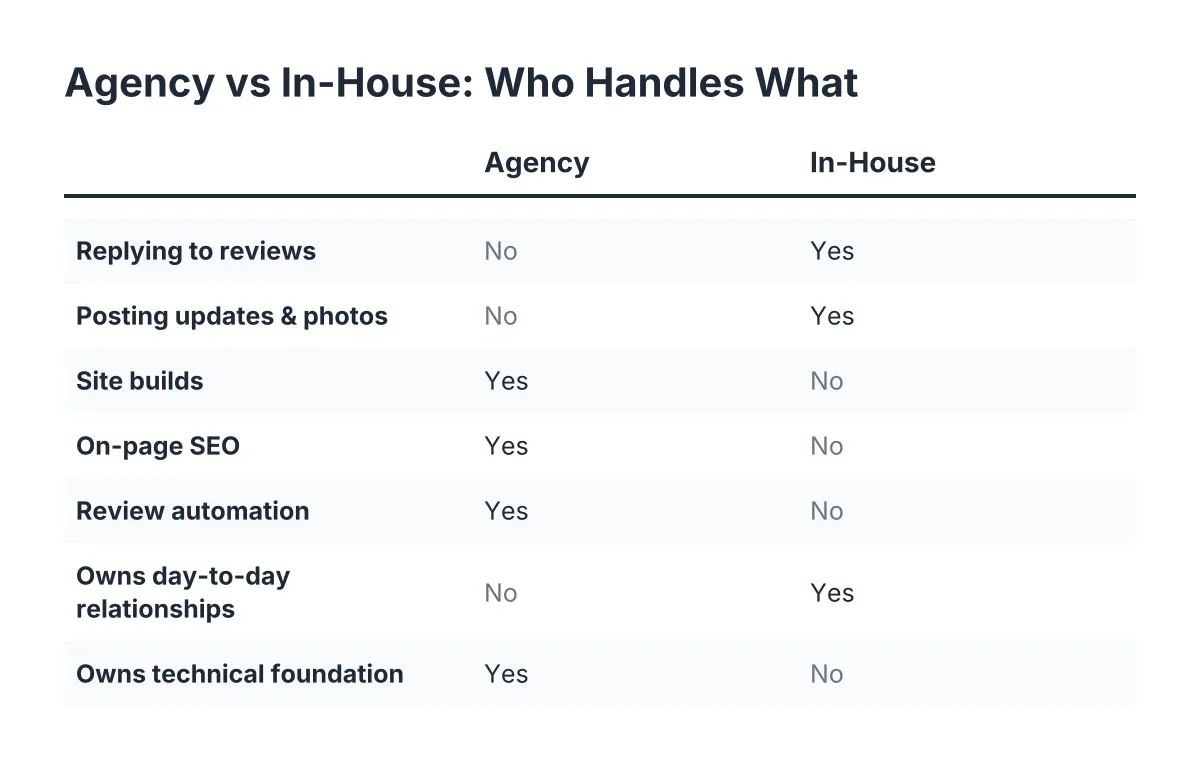
Hiring in-house gives you dedicated attention and deep knowledge of your business. That said, a full-time marketer is a serious payroll commitment, and one person rarely covers web design, SEO, review management, and ads equally well. An agency or specialized partner, by contrast, spreads that cost across a team with practiced systems. You typically pay less than a salary and get broader skill coverage, though you'll want a partner who knows local markets rather than a generalist shop built for national brands.
There's a related cost question owners often overlook: what you pay to get paid. The Federal Reserve's Small Business Credit Survey found that most small businesses face payments-related challenges, with leisure, hospitality, and retail firms most likely to cite card processing fees. Consequently, reviewing your payment processing alongside your marketing spend can free up budget you didn't know you had, and that freed-up budget often funds the very system upgrades this guide describes.
Whichever path you choose, judge it against the system outlined earlier in this guide. If a provider sells you one tactic in isolation, keep looking. You want the site, the search visibility, and the reviews working together, because that combination is what separates lasting local business marketing from a string of one-off campaigns.
Putting the System Together: A Practical Starting Checklist
If all of this feels like a lot at once, that's normal — the goal isn't to do everything today. Instead, focus on sequence. Start with the foundation, then layer on the pieces that compound over time.
- Claim and fully complete your Google Business Profile, including photos, hours, and service categories.
- Set up a simple system for asking every satisfied customer for a review, ideally automated.
- Make sure your website loads quickly on mobile and gives visitors an obvious way to call or book.
- Respond to every review, good or bad, within a few days.
- Revisit your payment processing and marketing budget together once a quarter.
Working through this list in order builds the flywheel described above: visibility feeds trust, trust feeds conversions, and conversions feed the reviews that restart the cycle. That's the practical shape of local business marketing done as a system rather than a scramble.
Ready to Get Started?
You don't need a dozen disconnected tactics. You need one system that gets you found, earns trust, and turns searches into bookings. If you'd rather run your business than run your marketing, we'd love to show you how a custom website, local SEO, and automated review collection work together in a single package built for businesses like yours.