Google Review Generation — Complete Guide
Most local business owners know they need more Google reviews, but few have a system that produces them consistently. Google review generation is the practice of turning happy customers into public five-star proof, using smart timing, the right ask, and automation instead of memory and hope. This guide covers why reviews carry so much weight, how to ask in a way customers actually respond to, and how automation removes the manual chasing entirely. Along the way, you'll find links to deeper articles on pricing and how done-for-you review automation works. If you're tired of watching competitors with worse work outrank you because they have 200 reviews and you have 14, this page is your starting point for building a real Google review generation system.
What You'll Find in This Guide
Why Google Review Generation Beats Every Other Trust Signal
Your Google reviews are the first impression most customers get, often before they see your website. Google hosts about 73% of all online reviews—more than six times as many as its nearest competitors combined. The battle for local trust happens almost entirely on your Google Business Profile, making Google review generation more valuable than Yelp, Facebook, or industry directories combined.
Nearly all consumers, 93%, say online reviews impact their purchase decisions. When a searcher compares three plumbers or two med spas, they usually pick the one with more reviews and a stronger rating. Review count and recency function as a ranking factor, a conversion factor, and a pricing factor simultaneously. Businesses with deep review profiles can charge more because trust reduces price sensitivity.
The encouraging part: the bar is lower than you think. Only 35% of small and midsize businesses have a Google Business Profile. Most that do ask for reviews inconsistently or not at all. You don't need to outspend anyone—just a repeatable system that asks every customer, every time, without relying on you to remember.
This consistency separates real review generation from review begging. A one-time push to your ten favorite customers produces a small spike, then silence. A system tied to your actual workflow produces a steady stream of fresh reviews month after month. Google notices recency and velocity, and so do customers scanning your profile. Our Google review automation service shows how every completed job can trigger a request automatically.
How to Ask Customers for Reviews the Right Way
Most owners get the ask wrong in one of two ways. Either they never ask, because it feels awkward, or they ask badly, with a vague "leave us a review sometime!" that goes nowhere. Fortunately, the fix is simple: ask at the right moment, through the right channel, with zero friction.
Timing Is Everything
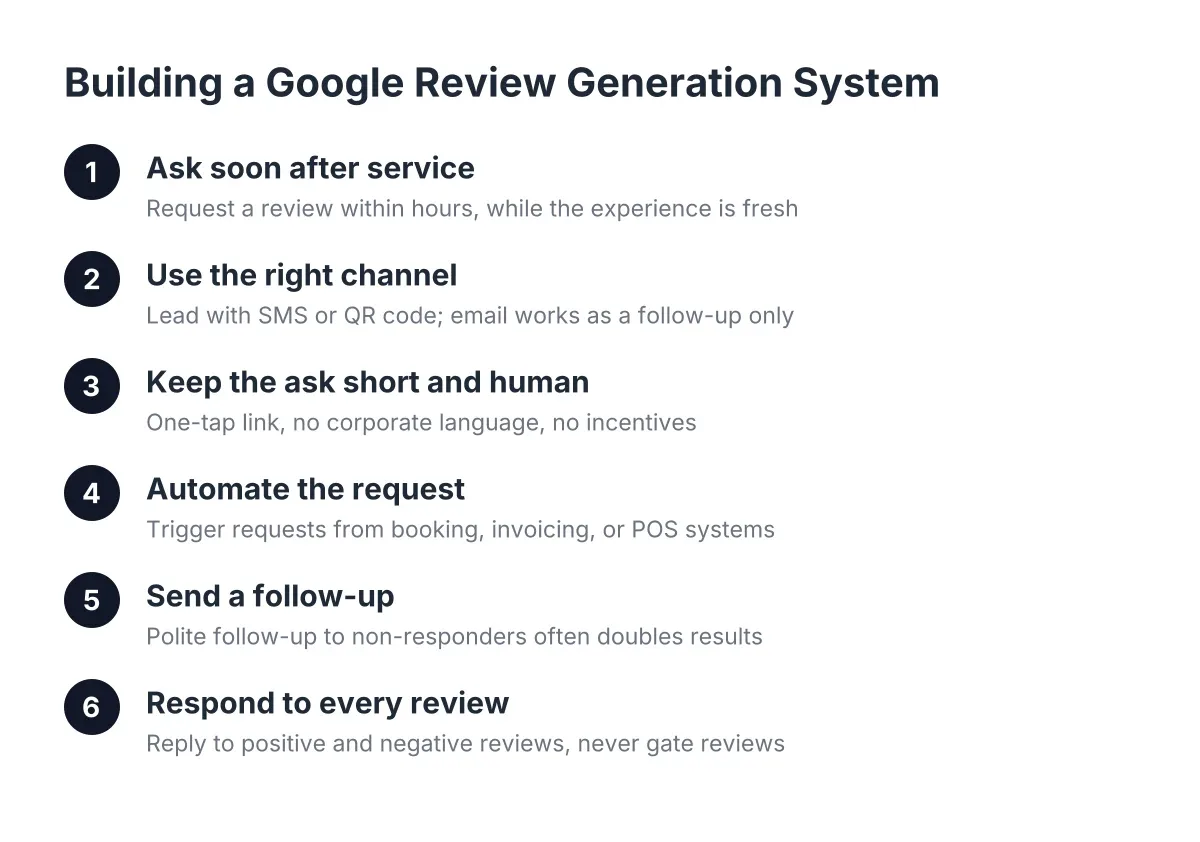
The best moment to ask is right after the customer experiences the value. For a contractor, that's the walkthrough at job completion. For a salon, it's as the client admires the result.Additionally, for a service call, it's within an hour of the technician leaving. Wait three days and the emotional high fades, and so does your response rate. This is why manual follow-up fails so often. You're busy running the business, so the ask slips to tomorrow, then never. An automated review request text message solves this by firing the moment the job closes in your system.
Text Beats Email, and Friction Kills Everything
Text messages get opened within minutes, while emails sit unread for days. Additionally, a text can carry a direct link that opens the Google review form in one tap. Every extra step you add cuts your response rate. If a customer has to search for your business, find the review button, and log in, most give up. To put it simply, the winning formula is a short, personal-sounding text with one link, sent within the hour.
Physical touchpoints help too. For example, a QR code card or stand at your counter lets in-person customers leave a review while they wait. The QR code should resolve to the same one-tap review link, not your homepage.
Make It Personal, Keep It Short
The message itself matters less than owners fear, but a few rules hold. Use the customer's name, and reference the actual job. Keep the message under three sentences. Never offer payment or discounts for reviews, since that violates Google's policies and federal rules. If you're weighing whether to build this yourself or subscribe to a tool, our guide on what a Google review automation subscription costs breaks down the trade-offs by volume and level of automation.
Automation, Review Gating, and Negative Reviews
Once you understand the mechanics of a good ask, the next question is scale. Sending one great review request is easy. Sending one to every single customer, forever, is where automation earns its keep, and it's the part of Google review generation most owners never get around to building.
What Review Generation Software Actually Does
Good review generation software connects to the tools you already use, such as your CRM, invoicing system, or booking calendar. When a job closes or a payment clears, the software sends the review request automatically. It then follows up once or twice with customers who didn't respond, because a polite reminder often doubles response rates. Beyond that, the better platforms track which requests converted, flag unhappy customers for a personal call, and even draft responses to new reviews. The result is a review pipeline that runs whether you're on a job site or on vacation. Pricing varies widely, which is why we published a full cost guide for review automation subscriptions covering what actually drives the price up or down.
Review Gating, Explained
Review gating means asking customers how they feel first, then only sending happy customers to Google while routing unhappy ones to a private form. It sounds clever. However, it violates Google's review policies, and the Federal Trade Commission's rule on fake and deceptive reviews targets exactly this kind of review suppression. The safe and legal approach is to ask everyone for a public review. That said, nothing stops you from also giving customers an easy private channel to raise problems. Most unhappy customers prefer a direct resolution over public venting, so you'll catch most issues anyway, without gating anyone.
How to Respond to Negative Reviews
A negative review is not a crisis. Instead, it's a public stage for showing how you handle problems. Respond within 24 hours, thank the reviewer, acknowledge the specific issue, and offer to make it right offline. Never argue, and never get defensive, because future customers judge your reply more than the complaint itself. In fact, BrightLocal found that 88% of consumers would use a business that replies to all of its reviews, compared to just 47% for one that never responds. That gap is one of the cheapest competitive advantages available. Additionally, a steady flow of new five-star reviews dilutes the occasional bad one, which is another reason consistent generation beats damage control.
Bringing It All Together
Reviews are not a side project you handle when things get quiet. They're a core growth channel that compounds over time, and every month without a system in place is a month competitors pull further ahead. A thoughtful approach to Google review generation combines the right timing, the lowest-friction channel, and automation that never forgets to ask. Once that system runs in the background, your job shifts from chasing reviews to simply doing great work, because the requests, follow-ups, and tracking happen on their own.
That said, none of this requires a marketing degree or a big team. It requires connecting the moment a customer feels satisfied to a request that reaches them within minutes, then repeating that process for every customer, every time. Small businesses that do this consistently pull ahead of competitors who rely on hope and memory, even when the underlying work is comparable. In practice, the businesses winning the local search results are rarely the most skilled; they're simply the most consistent about asking.
Ready to Get Started?
You don't need to become a marketer to build a five-star reputation. You need a system that asks every customer at the right moment, and we build that system for you, alongside a website designed to convert the trust those reviews create. Reach out and we'll show you exactly how many reviews your business could be generating each month.